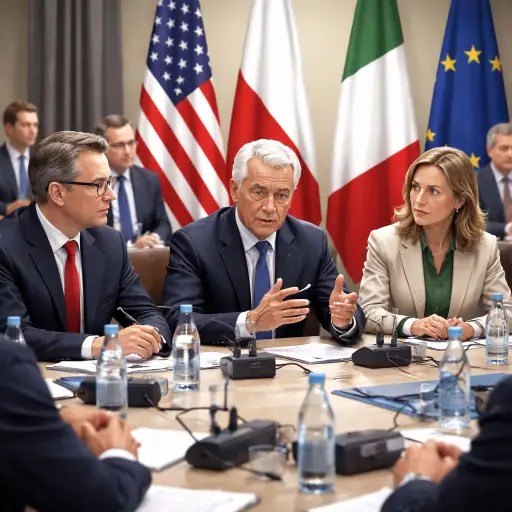
Warsaw and Rome cite structural concerns and constitutional limits, leaving the door open to future engagement if the framework evolves

In a development that signals fresh tensions in transatlantic diplomacy, Poland and Italy have announced that they will not participate in U.S. President Donald Trump’s newly proposed “Board of Peace,” an initiative unveiled as part of Washington’s broader effort to reshape international conflict mediation.
Both governments emphasized that their decision does not represent a withdrawal from cooperation with the United States, but rather reflects reservations about the initiative’s institutional design and legal implications. Officials in Warsaw and Rome stressed that they remain committed to multilateral diplomacy and open to reconsidering their stance should the structure of the board be revised.
The proposed Board of Peace, described by the White House as a flexible coalition of like-minded states aimed at accelerating conflict resolution and bypassing bureaucratic inertia, has already drawn scrutiny in several European capitals. While U.S. officials argue that the board would complement existing global institutions, critics fear it could duplicate or even undermine the role of the United Nations.
Poland’s prime minister underscored serious national doubts about the board’s current form. Speaking after consultations with parliamentary leaders, the premier said that while Poland shares Washington’s desire for more effective peace mechanisms, clarity is needed regarding governance, accountability, and the relationship between the board and established international bodies.
Diplomatic sources in Warsaw indicated that policymakers are wary of endorsing a structure that lacks a clearly defined legal basis under international law. Poland, which has positioned itself as a strong advocate of NATO cohesion and European Union coordination, is particularly sensitive to initiatives that could fragment Western unity or create parallel diplomatic tracks.
Italy’s position rests on a different, though related, foundation. Government representatives in Rome pointed to constitutional provisions that regulate Italy’s participation in international organizations and security arrangements. Legal advisers reportedly concluded that the Board of Peace, as currently conceived, does not neatly align with the constitutional framework governing Italy’s commitments abroad.
Italian officials also emphasized the country’s longstanding support for the United Nations system. Rome hosts several major UN agencies and has historically championed multilateral diplomacy as a cornerstone of its foreign policy. Any initiative perceived as competing with the UN’s authority is likely to face heightened scrutiny in Italy’s political and legal circles.
Despite declining to join at this stage, both Poland and Italy were careful to avoid closing the door entirely. In coordinated statements, their governments noted that they would continue to analyze developments related to the Board of Peace and remain open to engagement if adjustments are made to its mandate, membership criteria, and oversight mechanisms.
For Washington, the hesitancy of two key European partners presents an early test for the initiative’s viability. The administration has framed the Board of Peace as a pragmatic response to what it characterizes as paralysis within traditional institutions. Supporters argue that smaller, mission-focused coalitions can move more swiftly in mediating regional conflicts and enforcing ceasefires.
Yet European diplomats privately express concern that the emergence of alternative structures risks weakening the coherence of global governance. The fear is not necessarily that the Board of Peace would directly supplant the United Nations, but that it could create competing centers of legitimacy, complicating efforts to build broad international consensus.
Analysts note that the transatlantic relationship is entering a period of recalibration. While cooperation on defense and economic matters remains robust, differences over institutional reform and global governance models are becoming more pronounced. The debate over the Board of Peace illustrates a deeper question: how to modernize international conflict resolution without eroding the legitimacy of long-standing frameworks.
In Brussels, European Union officials are watching closely. Although the bloc has not adopted a unified position, internal discussions reportedly reflect similar concerns about duplication and legal ambiguity. For member states such as Poland and Italy, alignment with European treaty obligations is an essential consideration.
The coming weeks are likely to see intensified diplomatic consultations. U.S. representatives have signaled willingness to clarify the board’s relationship with the United Nations and other multilateral bodies, potentially through formal memoranda or observer arrangements. Whether such assurances will satisfy European skeptics remains uncertain.
For now, Warsaw and Rome are sending a calibrated message: partnership with Washington remains strong, but not unconditional. Their refusal to join the Board of Peace in its current iteration underscores a preference for institutional coherence and legal certainty over rapid experimentation.
As global conflicts continue to test the resilience of international diplomacy, the debate surrounding the Board of Peace may become a defining moment in the evolution of multilateralism. Whether the initiative adapts to European concerns or proceeds with a narrower coalition will shape not only its own future, but also the broader architecture of peacebuilding in the years ahead.