Leaders weigh innovation drives and strategic shields as Europe confronts dominance in key technologies and markets

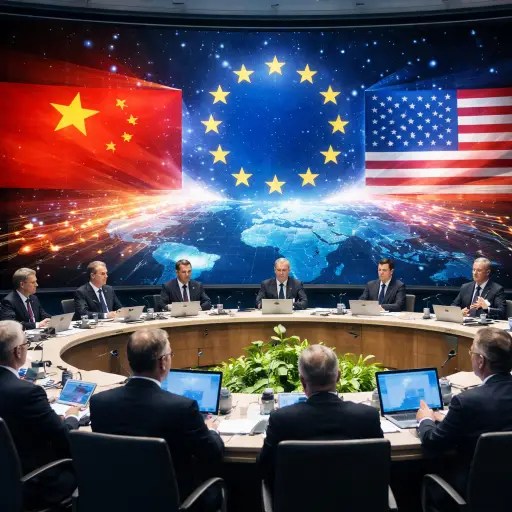
As Valentine’s season casts its familiar glow across Europe, EU leaders gathered for a markedly unsentimental exercise: a strategic brainstorming session on economic survival in a world increasingly shaped by Washington and Beijing.
Convened under the European Council, the closed-door retreat was framed not as a ceremonial summit but as a candid stocktaking of Europe’s vulnerabilities, with participants urged to speak openly about the structural pressures confronting the bloc.
At the center of discussions was the growing dominance of the United States and China in critical technologies ranging from artificial intelligence and advanced semiconductors to quantum computing, electric vehicles and green energy supply chains.
Several leaders acknowledged that while Europe remains a regulatory superpower and a major trading bloc, it risks falling behind in scaling innovation, commercializing research and mobilizing capital at the speed seen in its global rivals.
Innovation policy emerged as the least divisive theme, with broad support for deepening cross-border research funding, accelerating digital integration and strengthening the single market for services to allow European firms to grow without fragmentation.
Participants debated how to prevent promising startups from being acquired by foreign investors before reaching maturity, with proposals circulating to reinforce intellectual property protections and channel long-term investment into strategic sectors.
Shielding sensitive industries proved more contentious, as governments weighed stricter foreign investment screening and targeted export controls against Europe’s longstanding commitment to open markets and multilateral trade.
The United States’ expansive industrial policies, particularly in clean technology and advanced manufacturing, drew mixed reactions, with some leaders calling for comparable European instruments and others warning of fiscal overstretch and internal distortions.
China’s state-backed industrial scale was described as a different but equally complex challenge, as member states remain deeply intertwined with Chinese supply chains while seeking to reduce dependencies in critical raw materials and digital infrastructure.
Energy security and the green transition were woven into the debate, with emphasis on diversifying sources of lithium, cobalt and rare earth elements while building domestic capacity in batteries, hydrogen technologies and renewable components.
Longstanding divisions resurfaced over how interventionist Europe should become, with fiscally conservative governments cautioning against mutualized debt and relaxed state aid rules, while others argued that strategic autonomy requires bolder collective action.
The European Commission signaled that it would translate the summit’s reflections into proposals aimed at modernizing competition policy, strengthening capital markets integration and simplifying regulations that hinder cross-border growth.
Business leaders observing the discussions urged swift follow-through, noting that regulatory complexity and fragmented financing structures often weigh more heavily on European competitiveness than foreign subsidy programs alone.
While no sweeping declarations were issued, the gathering underscored a shared recognition that Europe must define a clearer economic identity, balancing openness with resilience and innovation with strategic protection.
In a geopolitical climate marked by intensifying rivalry between the United States and China, the summit’s message was understated but unmistakable: Europe’s economic survival will depend less on rhetoric and more on unity, speed and the political will to act.