Leaders Confront Rising Tensions from Washington, Beijing and Moscow While Recasting Europe’s Security and Economic Future
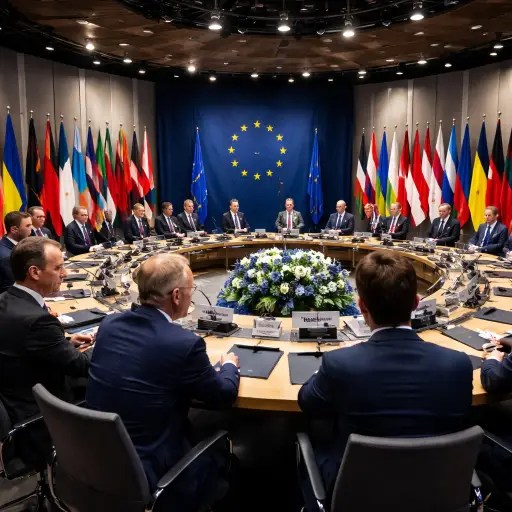
Against a winter sky and amid quiet countryside far from the traditional power corridors of Brussels, European leaders convened this week with an unmistakable sense of urgency. The informal summit in Bilzen-Hoeselt unfolded under the weight of mounting geopolitical strain, as the continent confronts intensifying pressure from the United States, China and Russia — alongside the destabilizing spillover of nearby wars.
The gathering, held close to Valentine’s Day, carried a symbolic undertone of solidarity. Yet behind closed doors, discussions were frank and at times tense. Unity remains the European Union’s most prized strategic asset, leaders insisted. But as conflicts redraw global alignments and economic competition hardens, differences over defence spending, trade exposure and strategic autonomy are surfacing with renewed force.
War at Europe’s Edge
Ongoing conflict on Europe’s eastern flank continues to reshape the continent’s security calculus. While the war remains geographically contained, its economic, cyber and political repercussions ripple across borders. Energy infrastructure vulnerabilities, hybrid threats and disinformation campaigns have become central concerns in policy debates.
Several leaders underscored the need to strengthen collective defence mechanisms, accelerate joint procurement of military equipment and reinforce NATO coordination. Others urged caution, wary of deepening fiscal strain at a moment when public budgets are already stretched by inflation and industrial transition.
“The question is no longer whether Europe must adapt,” one senior diplomat remarked privately. “It is how fast, and at what cost.”
Strategic Autonomy Revisited
The phrase “strategic autonomy” resurfaced repeatedly throughout the summit. Once controversial, it has gained traction as Europe navigates an increasingly transactional global order. Relations with Washington remain strong but occasionally strained, particularly over industrial subsidies and defence burden-sharing. Meanwhile, economic ties with Beijing are being recalibrated amid concerns over supply chain dependency and critical technologies.
France and several southern member states advocated for a more assertive European industrial policy, including expanded investment in green technologies, semiconductor manufacturing and defence production. Germany and northern economies emphasized safeguarding open markets while diversifying trade partnerships.
Behind these positions lies a shared recognition: Europe can no longer afford strategic complacency. The pandemic exposed vulnerabilities in medical and technological supply chains. War has underscored the fragility of energy routes. And rising geopolitical competition is compelling the bloc to reconsider how sovereignty and interdependence coexist.
Economic Resilience in Focus
Economic resilience formed a parallel pillar of the summit’s agenda. Leaders debated proposals to deepen capital markets integration, streamline regulatory frameworks and accelerate the green transition without undermining competitiveness.
Business leaders, invited for a closed session, warned that prolonged geopolitical tension could dampen investment and strain transatlantic trade. At the same time, they urged policymakers to provide clearer long-term signals on energy pricing and industrial strategy.
China’s expanding influence in emerging markets and infrastructure corridors was cited as both a challenge and an opportunity. While some member states favor a firmer stance toward Beijing, others stress the necessity of pragmatic engagement. The balancing act reflects Europe’s broader dilemma: defending values and security interests without isolating itself from key global partners.
Security Beyond the Battlefield
The summit also highlighted non-traditional security threats. Cyberattacks on public institutions, sabotage of critical infrastructure and election interference loom large ahead of upcoming national votes across the continent. Leaders agreed to enhance intelligence-sharing mechanisms and coordinate responses to hybrid aggression.
Climate-related security risks were another pressing theme. Extreme weather events and migration pressures are increasingly intertwined with geopolitical instability. Southern European nations pressed for stronger solidarity mechanisms, arguing that border management and humanitarian response must be viewed through a comprehensive security lens.
A Delicate Transatlantic Equation
Relations with the United States remain foundational but are evolving. European officials privately acknowledge concerns about the unpredictability of American domestic politics and its implications for long-term commitments abroad. While reaffirming the transatlantic alliance, several leaders called for Europe to shoulder greater responsibility for its own defence capabilities.
At the same time, trade disputes and industrial policy divergences continue to test diplomatic finesse. The push for domestic manufacturing incentives on both sides of the Atlantic has sparked fears of subsidy races. Negotiators are seeking frameworks that avoid fragmentation while preserving competitiveness.
Unity Tested, Unity Asserted
Despite divergent national priorities, the summit concluded with a carefully crafted message of cohesion. A joint communiqué emphasized commitment to collective defence, economic resilience and democratic values. Yet observers noted that consensus was achieved more through compromise than convergence.
Eastern member states pressed for accelerated defence integration. Mediterranean countries advocated for flexible fiscal rules to sustain growth. Smaller economies demanded safeguards against being sidelined in major industrial initiatives. The mosaic of perspectives underscores the complexity of steering a union of diverse interests through turbulent times.
Symbolism in a Quiet Setting
Hosting the summit in Bilzen-Hoeselt — away from the symbolic institutions of Brussels — was seen as a deliberate gesture. It underscored that Europe’s future is shaped not only in grand capitals but also in its regions and communities. The pastoral surroundings offered a contrast to the gravity of discussions within.
As leaders departed, there was no illusion that immediate solutions had been found. Instead, the meeting marked another step in Europe’s gradual strategic awakening. The wars beyond its borders, the rivalry among global powers and the demands of economic transformation are converging into a single imperative: adaptation.
In this season associated with unity and connection, Europe’s leaders face the task of translating rhetorical solidarity into operational coherence. The pressure is unlikely to ease. But the resolve expressed in Bilzen-Hoeselt suggests that the continent is preparing — cautiously, collectively and with eyes wide open — for a more contested world.


 The Tower Post