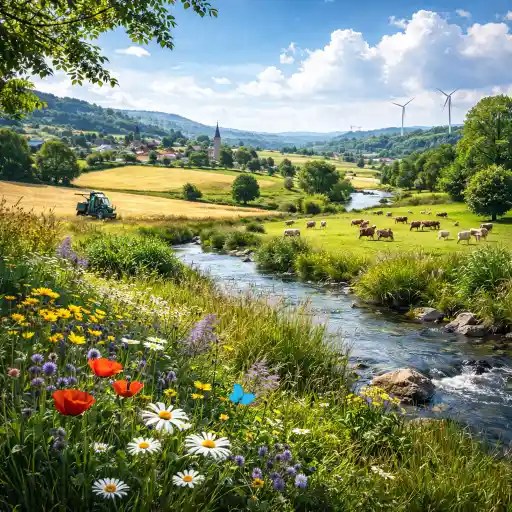
A new EU assessment shows environmental recovery advancing across the bloc, with leaders urging faster investment in ecosystems that sustain agriculture, industry and long-term stability.
In a political season associated with symbols of commitment and renewal, European leaders are highlighting a different kind of bond: the strengthening connection between nature and economic resilience. A newly released European Union report finds that the bloc is making significant progress toward global biodiversity targets, yet officials caution that faster action is required if ecosystems are to continue supporting food systems, water security and long-term economic stability.
The assessment presented by the European Commission concludes that restoration initiatives, expanded protected areas and more sustainable agricultural practices are beginning to reverse decades of environmental degradation. From wetland recovery in southern regions to forest regeneration in central Europe, measurable improvements are emerging across multiple habitats, with pollinator populations stabilizing in some areas and marine conservation zones expanding.
Policymakers are warning against complacency. Senior EU officials stress that nature should be viewed as foundational infrastructure, arguing that European economies depend on functioning ecosystems in much the same way they rely on transport systems, digital networks and energy grids.
The report draws a direct link between biodiversity progress and economic performance. Agriculture, still a pillar of the European economy, relies on fertile soils, reliable water supplies and pollination services, while resilient ecosystems help buffer crop yields against droughts and floods as climate volatility intensifies.
Industrial sectors are also exposed to environmental risks. Water-intensive manufacturing depends on stable river basins, pharmaceutical research draws upon biological diversity, and tourism economies across southern Europe rely on healthy landscapes and marine ecosystems that attract global visitors.
According to the findings, investments in biodiversity protection are already generating economic dividends in the form of greater predictability and reduced risk exposure. Restored wetlands are lowering flood damage costs, sustainable forestry practices are strengthening supply chains, and improved soil health is stabilizing agricultural productivity.
The EU’s biodiversity strategy, aligned with international commitments under the Kunming-Montreal Global Biodiversity Framework, aims to protect and restore degraded ecosystems while integrating sustainability into financial decision-making. Green financing instruments are channeling capital toward restoration projects, and corporate reporting standards increasingly require disclosure of nature-related risks.
Despite measurable progress, implementation gaps remain across several member states. Environmental groups argue that certain agricultural subsidies continue to favor intensive practices that strain soil and water resources, while policymakers acknowledge that regulatory coherence and cross-border coordination must improve.
Economic analysts emphasize that biodiversity loss carries clear fiscal consequences. Declining fisheries affect coastal employment, soil erosion drives up food prices, and water scarcity disrupts supply chains, whereas proactive conservation reduces long-term public expenditure by preventing environmental crises before they escalate.
Financial institutions are beginning to incorporate biodiversity metrics into investment models, assessing ecosystem dependency within broader risk frameworks. Early evidence suggests that nature-positive portfolios may offer stronger long-term stability as climate adaptation becomes central to economic planning.
Farmers adopting regenerative techniques such as crop rotation, agroforestry and reduced pesticide use report more stable yields and lower input costs over time. Although transition expenses can be substantial, EU funding mechanisms are designed to offset short-term burdens while encouraging systemic transformation of food systems.
Water security has emerged as a critical focus area, with river basin restoration improving retention capacity and reducing flood risks in vulnerable regions. Urban planners are expanding green infrastructure, integrating parks and restored waterways into city design to mitigate heat stress and enhance public health outcomes.
The broader message from EU policymakers is that environmental stewardship and economic resilience are inseparable. By framing biodiversity as natural capital rather than a niche environmental concern, leaders hope to strengthen political consensus around sustained investment in ecosystems.
As Europe reflects on partnership and shared responsibility, the symbolism resonates beyond policy circles. Protecting ecosystems is presented not only as a moral obligation but as a strategic safeguard for prosperity and stability in an increasingly uncertain global landscape.
The report concludes that while Europe is moving in the right direction, the scale of environmental and climate pressures demands continued acceleration. For EU leaders, the equation is clear: long-term economic resilience begins with a sustained commitment to nature.




 The Tower Post