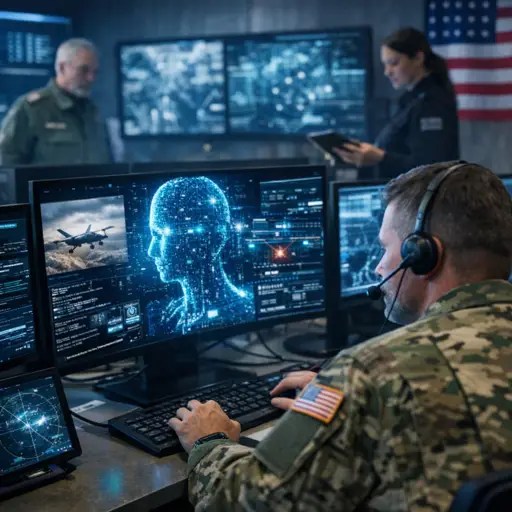
As trust and technology converge, the U.S. military deepens its embrace of advanced artificial intelligence across secure domains

In a decisive expansion of its digital modernization strategy, the Pentagon is moving to deploy frontier artificial intelligence systems across both unclassified and classified military networks, embedding advanced algorithms directly into the secure environments where the nation’s most sensitive operations are conducted.
Senior defense officials describe the effort as a structural shift rather than a pilot program, signaling that AI is transitioning from experimental toolsets to foundational infrastructure within the Department of Defense’s command, intelligence, logistics and operational ecosystems.
For years, much of the Pentagon’s artificial intelligence experimentation unfolded in unclassified sandboxes, where developers refined large language models, predictive analytics engines and multimodal systems designed to process imagery, signals and battlefield data, but those systems rarely crossed into the classified networks that power real-world decision-making.
Now, amid intensifying geopolitical competition and rapid advances in commercial AI, defense leaders say limiting advanced models to isolated environments risks falling behind adversaries who are racing to operationalize machine learning across their own military architectures.
The integration of frontier AI into classified domains is intended to give commanders, analysts and planners real-time access to sophisticated tools capable of synthesizing vast streams of intelligence, identifying patterns across disparate datasets and accelerating operational planning cycles without compromising security.
Officials familiar with the initiative say the expansion requires hardened computing infrastructure, carefully segmented network environments and continuous monitoring protocols designed to prevent data leakage, model manipulation or unauthorized access within secure systems.
Cybersecurity specialists are building protected enclaves within classified networks where AI models can operate under strict governance controls, ensuring that sensitive intelligence inputs remain compartmentalized while still enabling advanced analytical processing.
The challenge extends beyond security architecture, as military leaders must also cultivate trust in systems whose outputs may influence high-stakes operational decisions, prompting expanded validation testing, red-team exercises and layered human oversight mechanisms.
Defense officials emphasize that AI tools will augment rather than replace human judgment, assisting with intelligence fusion, logistics forecasting, cyber threat detection and scenario modeling while leaving final authority firmly in human hands.
Industry partners, including major defense contractors and emerging AI firms, are working alongside government engineers to adapt commercial frontier models for secure deployment, retraining systems on vetted datasets and embedding guardrails tailored to classified environments.
The move aligns with broader Pentagon modernization priorities that emphasize digital resilience, distributed command-and-control and data-driven operations across air, land, sea, space and cyberspace, domains increasingly defined by speed and information dominance.
Analysts say embedding advanced AI directly into classified systems could compress decision timelines and sharpen situational awareness, particularly in fast-moving crises where minutes can determine strategic outcomes.
At the same time, critics warn that greater reliance on complex algorithms introduces new ethical and operational questions, including transparency, accountability and the potential for unintended bias in automated analytical outputs.
Pentagon leaders counter that structured governance frameworks, rigorous auditing procedures and continuous model evaluation are being strengthened precisely to mitigate such risks as AI systems become more deeply woven into defense workflows.
The expansion also reflects a cultural evolution inside the Department of Defense, where technologists, cyber operators and traditional military planners are increasingly collaborating to integrate data science into daily operational routines.
Training initiatives are underway to ensure personnel understand both the capabilities and limitations of advanced AI tools, reinforcing the principle that technological acceleration must be matched by disciplined oversight.
The broader message from defense leadership is clear: artificial intelligence is no longer peripheral to military strategy but central to maintaining technological advantage in an era defined by rapid innovation and strategic uncertainty.
As frontier AI systems begin operating within the secure digital arteries of the U.S. military, the Pentagon is signaling that the future of defense will be shaped not only by hardware and manpower but by the algorithms that interpret, anticipate and inform decisions at every level of command.