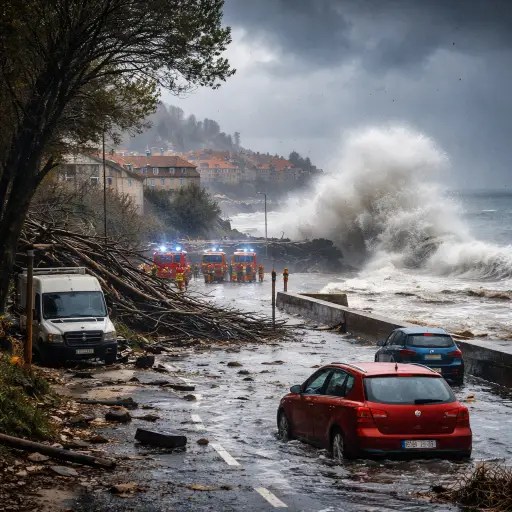
Hurricane-force winds and relentless floods plunge France, Spain and Portugal into chaos as emergency crews battle destruction on a day meant for warmth and unity

Western Europe awoke to scenes of devastation as Storm Nils roared in from the Atlantic, battering France, Spain and Portugal with hurricane-force winds and torrential rain that overwhelmed rivers, shattered infrastructure and forced hundreds of thousands of residents into darkness.
In southwestern France, a truck driver was killed when a massive tree, torn from saturated ground by violent gusts, crashed onto his vehicle along a regional highway, underscoring the lethal force of a storm system that authorities say intensified with alarming speed before making landfall.
Nearly 850,000 homes across France lost power as red wind alerts were issued in multiple departments, leaving entire neighborhoods without electricity while utility crews struggled to reach damaged lines blocked by debris and continuing gusts that rendered repair operations dangerous.
Transport networks across the affected regions were thrown into chaos, with high-speed rail services suspended in western France after overhead lines were damaged and tracks obstructed by fallen trees, while regional trains in Spain and key highways in Portugal were halted due to flooding and landslides.
Air traffic faced severe disruption as crosswinds exceeded operational limits at several airports, grounding aircraft and stranding passengers in terminals where departure boards flickered with cancellations and indefinite delays.
In northern Spain, coastal communities endured towering waves and storm surges that swallowed promenades and flooded low-lying districts, while Portuguese authorities reported rivers bursting their banks and cutting off rural villages as emergency teams deployed boats to assist stranded residents.
Schools were closed across the hardest-hit areas as local governments urged residents to remain indoors, activating evacuation protocols in flood-prone zones and converting sports halls and community centers into temporary shelters for displaced families.
Firefighters and civil protection units worked through the night responding to thousands of emergency calls ranging from collapsed roofs to submerged vehicles, warning that saturated soils and weakened tree roots continue to pose significant risks even as winds begin to ease.
Meteorologists described Nils as one of the most powerful winter storms in recent memory, fueled by an unusually energized Atlantic system and a volatile jet stream pattern that amplified wind speeds and rainfall intensity across Western Europe.
Economic analysts anticipate repair costs reaching into the hundreds of millions of euros as insurers prepare for a surge in claims related to structural damage, flooded properties and agricultural losses in vineyards and orchards battered by relentless rain.
Despite the destruction, scenes of solidarity emerged across the region as neighbors checked on elderly residents, volunteers distributed blankets and warm meals, and families gathered in candlelit homes, transforming an evening traditionally associated with affection into one defined by resilience and collective resolve.
As authorities continue to assess the human and material toll, the priority remains restoring power, reopening transport corridors and stabilizing vulnerable structures, yet for many communities the aftermath of Storm Nils will endure long after skies clear, leaving a stark reminder of nature’s capacity to disrupt even the most ordinary moments.