Rising U.S. tariffs and surging Chinese imports narrow the bloc’s external balance, testing Europe’s economic resilience at a pivotal moment

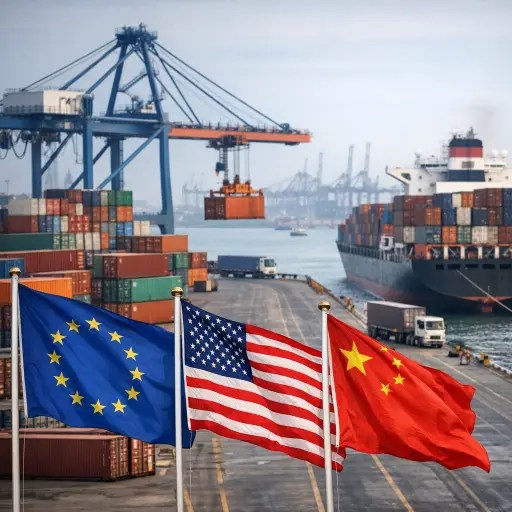
The European Union’s long-standing trade surplus is narrowing as global pressures intensify, reflecting a more fragmented trading environment shaped by higher U.S. tariffs and a renewed surge of Chinese imports that are reshaping the bloc’s external accounts at a delicate juncture for policymakers and industry leaders.
For years the surplus acted as a stabilizing pillar for the EU economy, supported by robust exports of machinery, vehicles and chemicals that reinforced Europe’s position as one of the world’s leading manufacturing hubs, but recent trade flows suggest that this buffer is thinning as external demand weakens and competitive pressures mount.
Exports of capital goods and industrial machinery have softened noticeably, with manufacturers reporting fewer new orders from overseas clients and longer decision cycles as businesses reassess supply chains amid geopolitical tensions and tariff barriers that complicate cross-border commerce.
The automotive sector, long emblematic of European industrial strength, is facing a combination of slower demand in the United States and intensifying competition in electric vehicles, forcing producers to recalibrate output and reconsider investment strategies in an environment marked by policy uncertainty and shifting consumer preferences.
Chemical exporters are encountering parallel challenges, grappling with higher production costs linked to energy prices while also contending with more aggressive pricing from global competitors, factors that collectively erode margins and dampen export performance.
The United States remains the bloc’s largest single external market, and the introduction of additional tariff measures on selected industrial goods has begun to weigh on trade volumes, raising costs for European producers and reducing their price competitiveness in a market that has historically absorbed a substantial share of high-value EU exports.
At the same time imports from China have gained renewed momentum, with European businesses sourcing competitively priced components, electronics and manufactured goods that help contain domestic inflation but simultaneously expand the import bill and contribute to the contraction of the overall surplus.
Economists caution that the narrowing trade balance does not signal an immediate crisis but does highlight structural vulnerabilities that have been debated for years, including reliance on external demand, uneven productivity growth and lingering fragmentation within the single market.
Business associations across member states stress that predictability in trade policy is as important as cost, arguing that prolonged uncertainty discourages capital expenditure and delays strategic decisions that are essential for maintaining technological leadership and export capacity.
Despite the headwinds the European Union continues to record a surplus rather than a deficit, underscoring the resilience of its industrial base and the depth of its integration into global value chains, yet analysts note that the margin for complacency is shrinking as competition intensifies and geopolitical risks persist.
Policy discussions in Brussels increasingly center on strengthening internal investment and accelerating structural reforms designed to enhance productivity, deepen capital markets integration and foster innovation in strategic sectors ranging from clean technologies to advanced manufacturing.
Several member states advocate targeted support for industries deemed critical to long-term competitiveness, while also emphasizing the need to streamline regulation and reduce administrative burdens that can hamper the agility of firms operating in rapidly evolving global markets.
Small and medium-sized enterprises, often the backbone of Europe’s export ecosystem, are particularly exposed to tariff costs and demand fluctuations, prompting calls for improved access to financing tools and export credit mechanisms that would enable them to diversify markets and withstand external shocks.
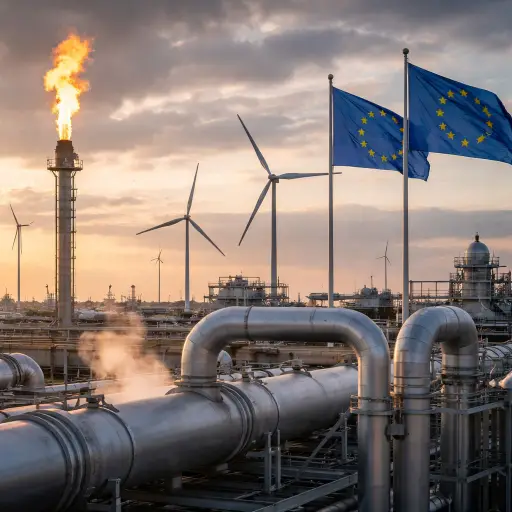
Energy policy remains intertwined with trade performance, as elevated energy costs in recent years have weakened heavy industry relative to international peers, and progress in renewable deployment and grid modernization is widely viewed as a pathway to restoring cost competitiveness and supporting industrial renewal.
Financial markets are closely monitoring the evolution of the trade balance given its implications for currency dynamics and investor confidence, with analysts suggesting that sustained erosion could influence capital flows and shape broader macroeconomic perceptions of the bloc’s economic trajectory.
Ultimately the contraction of the EU trade surplus reflects a transitional phase rather than a structural collapse, yet it serves as a clear signal that adaptation is imperative in a world defined by strategic rivalry and shifting alliances where resilience will depend less on external demand and more on the strength of internal investment and reform momentum.