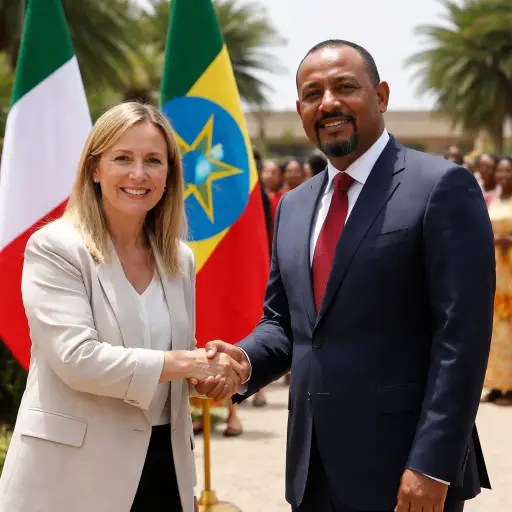
Prime Minister Giorgia Meloni advances the Mattei Plan in Ethiopia, deepening cooperation on development, migration and trade while facing scrutiny over transparency and local participation.
Italian Prime Minister Giorgia Meloni used a high-profile visit to Ethiopia to reaffirm her ambition to reposition Italy as a central bridge between Europe and Africa, promoting a strategy that blends development financing, migration management and trade expansion under her government’s flagship Mattei Plan.
Meeting Ethiopian leaders in the capital, Meloni framed the relationship as part of a broader European recalibration toward the African continent, arguing that long-term stability and shared prosperity require structured partnerships rather than emergency responses driven by crises.
The visit underscores Italy’s determination to carve out a distinctive geopolitical role at a time of intensifying global competition in Africa, where China, Gulf states, Turkey and other actors have steadily expanded their economic and diplomatic footprints through infrastructure investment and energy deals.
At the center of Rome’s outreach is the Mattei Plan, named after Enrico Mattei, the founder of Italy’s energy giant ENI, whose mid-twentieth-century approach emphasized negotiated partnerships with producing countries rather than purely extractive arrangements.
Meloni’s government presents the plan as a blueprint for equal cooperation built on energy interconnections, transport corridors, digital infrastructure and vocational training, with projects spanning multiple African countries and backed by a mix of public resources, development finance and private capital.
Ethiopia occupies a strategic place in that framework, not only as one of Africa’s most populous nations but also as host of the African Union headquarters, giving Addis Ababa symbolic and diplomatic weight within continental policymaking.
Italian officials highlighted collaboration in renewable energy, agricultural modernization and water management as examples of sectors where Italian expertise and Ethiopian priorities can converge, particularly as Addis Ababa pursues economic reforms and reconstruction efforts.
For Meloni, the Africa pivot is closely intertwined with migration policy, an issue that has defined her domestic political agenda and shaped Italy’s posture within the European Union.
During talks in Addis Ababa, discussions included cooperation on border governance, combating human trafficking networks and expanding legal migration channels linked to labor market needs in Italy, reflecting a strategy that couples deterrence with development incentives.
Supporters of the approach argue that addressing the structural drivers of irregular migration requires investment in job creation, education and energy access, contending that economic opportunity at home can reduce the pressure to migrate under precarious conditions.
Critics, however, caution that tying development cooperation too closely to migration control risks distorting priorities and subordinating long-term development objectives to short-term European political concerns.
Civil society representatives and policy analysts have also raised questions about transparency and governance within the Mattei Plan, noting that while the political narrative is ambitious, detailed information about project selection, funding criteria and monitoring mechanisms remains limited.
In Ethiopia, observers have expressed cautious optimism about expanded economic engagement with Italy but emphasize that large-scale infrastructure and energy projects must be aligned with national development strategies and shaped through meaningful consultation with affected communities.
Local participation, they argue, is essential to ensure that partnerships generate durable social and economic benefits rather than reinforcing perceptions of externally driven agendas.
Rome insists that the Mattei Plan is designed to complement broader European Union strategies, positioning Italy as a policy entrepreneur capable of leveraging its historical ties and Mediterranean geography to strengthen Europe’s collective engagement with Africa.
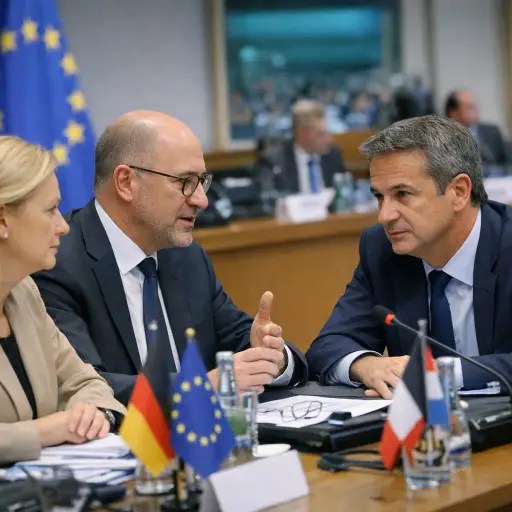
Diplomats in Brussels view Italy’s activism as both an opportunity and a test, with some hoping that national initiatives can inject momentum into EU frameworks while others watch to see whether commercial interests will dominate over multilateral coordination.
For Ethiopia, the outreach from Rome offers a chance to diversify international partnerships at a time when the country is navigating complex economic reforms and seeking foreign investment to bolster growth and stability.
Italian companies bring technical expertise in engineering, agro-industry and renewable energy that aligns with Ethiopia’s development priorities, particularly as the government seeks to expand power generation and modernize key sectors of its economy.
Yet Ethiopian analysts stress the importance of fair risk-sharing arrangements, environmental safeguards and clear contractual terms to prevent debt vulnerabilities or uneven distribution of gains.
The broader geopolitical context adds further weight to the visit, as Europe grapples with energy security concerns and supply chain disruptions that have underscored the strategic relevance of closer ties with resource-rich and fast-growing African economies.
Meloni has repeatedly argued that a revitalized Europe-Africa partnership can serve mutual interests by fostering energy cooperation, strengthening food security and promoting industrial value chains that benefit both sides of the Mediterranean.
The symbolism of the Ethiopian stop was reinforced by the emphasis on dialogue and long-term vision, with Italian officials portraying the engagement as part of a generational shift in how Europe relates to Africa.
Still, translating vision into measurable outcomes will require sustained financing, institutional coordination and political continuity, factors that often challenge ambitious foreign policy initiatives once initial momentum fades.
As Meloni concluded her meetings in Addis Ababa, the contours of Italy’s Africa strategy appeared more defined but far from complete, with implementation set to determine whether the Mattei Plan becomes a transformative framework or remains a diplomatic slogan.
For now, the visit signals that Italy intends to anchor its future influence not only in European capitals but also in African ones, betting that deeper partnerships in places like Ethiopia will shape the next chapter of Europe-Africa relations.

 The Tower Post