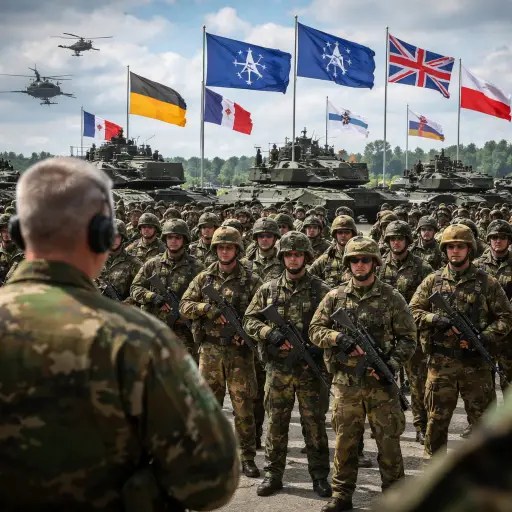
Alliance commander calls for more troops, equipment and joint procurement as Europe confronts mounting security pressures
As winter holds Europe in its grip, NATO’s top military commander has issued a forceful call for European armies to expand their ranks and accelerate rearmament, warning that the alliance must adapt more quickly to mounting security threats if it is to maintain credible deterrence across the continent.
Speaking at NATO headquarters, the alliance’s senior uniformed official said European allies need to increase troop numbers, replenish depleted stockpiles and invest in modern capabilities to meet updated capability targets agreed by member states, arguing that the strategic landscape has shifted faster than many governments anticipated.
He pointed to persistent instability along Europe’s eastern flank, intensifying geopolitical rivalry and the growing complexity of hybrid threats, including cyber operations and attacks on critical infrastructure, as evidence that the security environment demands a broader and more resilient military posture.
The commander stressed that while political leaders have pledged higher defence spending in recent years, the true measure of commitment lies in deployable formations that are properly staffed, trained and equipped, not merely in budget lines or long term procurement promises.
Across much of Europe, recruitment has emerged as a central challenge, with armed forces struggling to attract young people in competitive labor markets and amid demographic trends that are shrinking the pool of eligible candidates, forcing defence ministries to rethink traditional personnel models.
In several countries, debates over reintroducing or expanding forms of conscription have returned to the political mainstream, reflecting a growing recognition that voluntary enlistment alone may not be sufficient to meet NATO force planning requirements in an era of renewed great power competition.
While acknowledging that national approaches will differ, the NATO commander made clear that the alliance’s regional defence plans depend on having enough soldiers to fill multinational brigades, reinforce vulnerable front line states and sustain high intensity operations over time.
Beyond manpower, he underscored the urgent need to address equipment gaps that have become increasingly visible since the outbreak of large scale war in Europe, noting that ammunition stocks, air defence systems and armored vehicles must be replenished and expanded simultaneously.
European allies have provided significant military assistance to Ukraine, a commitment widely seen as vital to continental security, yet those transfers have also exposed weaknesses in industrial capacity and the limited depth of national inventories built during decades of reduced defence spending.
The commander called for enhanced joint procurement and greater standardization across European armed forces, arguing that fragmented acquisition practices have too often resulted in duplicated systems, higher costs and reduced interoperability among allies.
By pooling demand and coordinating long term contracts, governments could provide defence industries with the predictability needed to expand production lines, invest in skilled labor and secure critical supply chains, thereby strengthening what he described as the industrial backbone of deterrence.
Industry leaders have echoed those concerns, warning that scaling up production cannot happen overnight and requires sustained political commitment rather than short term surges, especially as global competition for raw materials and advanced components intensifies.
In recent years, many European NATO members have pledged substantial increases in defence budgets, with several meeting or exceeding alliance spending benchmarks and others setting out multi year plans to do so, reflecting a broader shift in public and political attitudes toward security.
Yet alliance officials increasingly emphasize that spending targets are a means rather than an end, insisting that investments must translate into operational capability, rapid mobility and the ability to integrate seamlessly with allied forces under NATO command structures.
The commander framed the expansion of European forces not as an act of provocation but as a stabilizing necessity, arguing that clear and credible deterrence reduces the risk of miscalculation and strengthens the transatlantic partnership at a time of heightened uncertainty.
He highlighted recent progress, including the reinforcement of multinational battlegroups, expanded high readiness formations and more complex joint exercises designed to test the rapid movement of troops and equipment across European territory.
Even so, he cautioned that adaptation must be continuous, as adversaries evolve their tactics and technologies, making resilience in areas such as cyber defence, space capabilities and logistics as critical as traditional land, air and naval power.
For European governments, the message is stark but measured: meeting alliance capability targets will require difficult political choices, sustained investment and, in some cases, a redefinition of the social contract between citizens and the armed forces they support.
As defence ministers prepare for further consultations in the coming weeks, the alliance’s military leadership is signaling that the window for incremental change has narrowed, and that building larger, more capable European forces is no longer optional but central to safeguarding the continent’s security in an increasingly contested world.

 The Tower Post