Hard-fought victory over Italy keeps momentum alive after stunning Finland, with Sweden looming in decisive group test

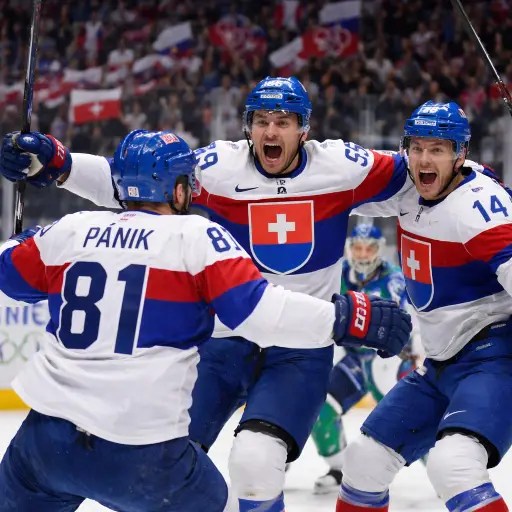
Slovakia’s remarkable run at the Winter Olympics in Milan gathered further force in mid-February as they edged Italy 3–2 in a gripping Group B contest, preserving their flawless record and reinforcing the growing sense that this squad has arrived on the Olympic stage with serious intent.
In a tournament that often punishes hesitation, Slovakia have shown none, combining structure, discipline and opportunism to secure back-to-back victories that have altered the complexion of the group and elevated expectations both at home and across the hockey world.
The latest triumph did not come easily, as a determined Italian side fed off the energy of a vocal crowd and forced Slovakia to defend with composure during long stretches of sustained pressure.
Slovakia opened with purpose, moving the puck crisply through the neutral zone and establishing an assertive forecheck that unsettled the Italian defense in the early exchanges.
That early pressure paid dividends when a controlled cycle behind the net created space in the slot, allowing Slovakia to strike first with a sharp finish that briefly silenced the arena.
Italy responded with resilience, matching Slovakia’s physicality along the boards and capitalizing on a momentary lapse in coverage to draw level, a goal that reignited the crowd and shifted the emotional tempo of the contest.
For a period the game became a battle of will as both teams traded heavy checks and contested every inch of ice, with Slovakia briefly retreating into a compact defensive shell designed to absorb pressure and limit high-danger chances.
The turning point arrived late in the middle frame when Slovakia earned a power-play opportunity through patient puck control and disciplined movement that forced Italy into a costly penalty.
On the ensuing advantage, a blistering one-timer from the right circle restored Slovakia’s lead and reasserted their authority at a critical juncture.
Moments later, a quick turnover at center ice was punished ruthlessly, as a Slovak forward broke clear and finished with clinical precision to extend the margin and quiet the previously buoyant crowd.
Yet the contest was far from settled, and Italy ensured a tense finale by narrowing the deficit with a deflected effort early in the third period that left the outcome hanging in the balance.
As the clock wound down, Italy pressed forward and eventually withdrew their goalkeeper in pursuit of an equalizer, forcing Slovakia into a nerve-testing defensive stand that showcased their maturity under pressure.
Shot blocks were thrown without hesitation, clearances were measured rather than hurried, and the bench remained composed even as the arena’s volume surged with each Italian attempt.
When the final horn sounded, Slovakia’s players celebrated not with relief alone but with a visible sense of conviction that their unbeaten status is no longer a fleeting headline but a reflection of sustained quality.
That belief was seeded earlier in the tournament with a surprise victory over Finland, a result that sent ripples through the competition and signaled that Slovakia are capable of disrupting the established order.
Against Finland, Slovakia demonstrated tactical discipline and opportunistic finishing, neutralizing their opponent’s speed through structured positioning and capitalizing on limited openings with ruthless efficiency.
The blueprint from that upset was evident again against Italy, as Slovakia balanced defensive responsibility with calculated risk, choosing their moments to accelerate and maintaining cohesion when the momentum swung against them.
Central to their success has been a blend of youthful energy and seasoned leadership that allows the team to adapt seamlessly to different phases of play.
Emerging talents have injected pace and creativity into the forward lines, while experienced figures provide stability during high-stakes moments, ensuring that emotional surges do not disrupt structural integrity.
The defensive unit, meanwhile, has displayed an increasingly confident command of space, limiting rebounds and supporting the goaltender with intelligent positioning that reduces exposure to second-chance opportunities.
Special teams have also played a decisive role, with the power play proving efficient and the penalty kill demonstrating discipline that minimizes unnecessary risk in critical stretches.
Now attention shifts to a formidable final preliminary challenge against Sweden, a side renowned for depth, technical precision and the ability to dictate tempo through layered offensive pressure.
For Slovakia, the impending clash represents both a measuring stick and an opportunity, a chance to validate their momentum against one of the tournament’s traditional heavyweights.
Coaches have emphasized consistency rather than celebration, reminding players that early success offers no guarantees once the knockout rounds begin.
Still, the psychological advantage of entering the final group fixture unbeaten cannot be understated, particularly in a tournament environment where confidence can tilt closely contested encounters.
Analysts have noted Slovakia’s improved puck management and reduced penalty exposure compared to previous Olympic campaigns, indicators of a team that has matured tactically and emotionally.
Beyond statistics, however, there is an intangible quality to this Slovak side, a collective resolve that surfaces in decisive moments and sustains them through adversity.
The closing minutes against Italy encapsulated that spirit, as discipline, unity and trust in structure overrode the instinct to panic under pressure.
Such resilience will be essential against Sweden, whose fluid attack demands unwavering concentration and whose defensive depth punishes careless turnovers.
For now, Slovakia occupy a position of promise within Group B, their unbeaten run reshaping expectations and compelling rivals to recalibrate their assessments.
Whether this surge culminates in a deep Olympic run remains to be seen, but the foundations have been laid through composure, clarity of purpose and a refusal to be overwhelmed by occasion.
As the Winter Games continue in Milan, Slovakia have transformed from intriguing outsiders into credible contenders, their performances carrying both technical substance and emotional resonance.
If the trajectory holds, this February may mark not only a string of victories but the redefinition of Slovakia’s modern Olympic hockey identity, forged in discipline and sustained by belief.