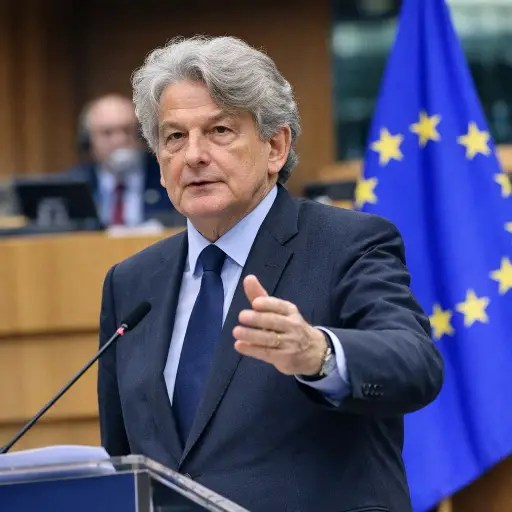
Former European Commissioner Thierry Breton positions himself as the architect of a new European sovereignty, urging rapid cuts to strategic dependencies in energy, technology and health as France moves toward a pivotal election.

As winter settles across Europe, Thierry Breton has re-emerged on the political stage with a stark warning: the continent is dangerously exposed and time is running out to correct its course.
The former European Commissioner is increasingly positioning himself as a central figure in the debate over Europe’s geopolitical and economic vulnerabilities, casting his experience in Brussels as proof that he can steer both France and the European Union through a period of mounting uncertainty.
In public appearances and policy forums, Breton argues that Europe’s reliance on external powers in critical sectors has become a structural weakness that threatens its sovereignty, prosperity and global influence.
Energy, technology and health form the backbone of his proposed strategy, with Breton calling for an accelerated reduction of dependencies that he believes leave the continent vulnerable to supply disruptions, price shocks and political pressure.
He contends that Europe must dramatically expand domestic energy infrastructure, reinforce semiconductor production capacity and secure pharmaceutical supply chains within its own borders in order to guarantee strategic autonomy.
Breton frames this agenda not as economic nationalism but as pragmatic realism, insisting that true partnership with global powers can only exist when Europe negotiates from a position of strength rather than dependence.
The message resonates in a France where traditional political alignments are increasingly fluid and voters are searching for leadership capable of combining economic security with international credibility.
By blending technocratic expertise with a rhetoric of sovereignty, Breton seeks to bridge ideological divides, appealing to pro-European centrists while also echoing themes that resonate with voters concerned about national control and resilience.
His critics warn that an aggressive reshoring of supply chains could inflate costs and strain trade relations, arguing that Europe’s prosperity has long been rooted in openness and global integration.
Others question whether Breton’s portrayal of himself as a guardian of European autonomy oversimplifies the structural nature of the challenges, which stem from decades of interconnected policy choices and economic interdependence.
Yet the geopolitical backdrop strengthens his argument, as ongoing tensions between major powers and recurring supply chain disruptions underscore how swiftly external shocks can reverberate through European economies.
Breton maintains that recent crises have provided hard lessons and that failure to act decisively now would amount to strategic negligence, leaving Europe exposed in an increasingly competitive world.
His positioning ahead of the forthcoming French presidential contest reflects a calculated effort to translate his European credentials into national political capital, presenting himself as both architect and executor of a new sovereignty agenda.
Whether voters will embrace this self-styled role as Europe’s saviour remains uncertain, but Breton’s re-entry into the political arena signals that strategic autonomy is set to become a defining theme of the campaign season.
In framing Europe’s future as a choice between vulnerability and resilience, Breton is betting that calls for unity, industrial strength and controlled interdependence will carry weight with an electorate wary of instability and eager for reassurance.