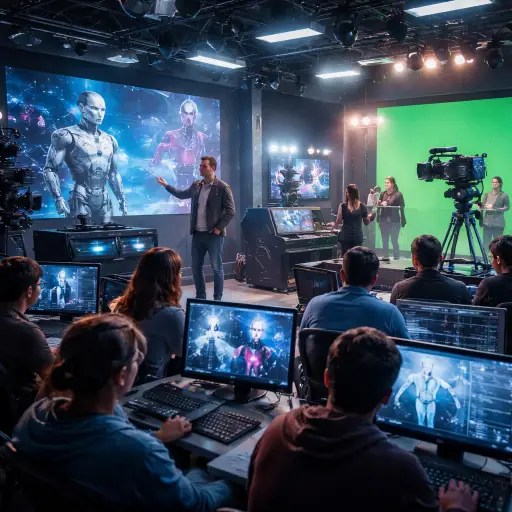
A new generation of filmmakers learns to collaborate with algorithms as artificial intelligence becomes central to production.
Hollywood is rewriting its own script as artificial intelligence moves from the margins of experimentation to the center of film production culture.
A newly launched AI-focused film school in Hollywood is training directors, editors, screenwriters and visual artists to work fluently inside AI-powered production workflows, signaling a structural shift in how the entertainment industry prepares its future workforce.
The initiative emerges at a moment when generative systems are no longer confined to research labs but are embedded in previsualization, script development, virtual production, visual effects and marketing, compressing timelines that once stretched across months into cycles measured in days.
Inside classrooms situated near historic studio lots, students move seamlessly between discussions of story arcs and demonstrations of neural rendering engines, learning how prompt design, dataset curation and iterative generation can shape the earliest stages of cinematic creation.
Instructors insist that the objective is not replacement but augmentation, arguing that artificial intelligence functions best as a creative collaborator that accelerates experimentation while leaving authorship and intention firmly in human hands.
Coursework blends traditional film grammar with computational literacy, teaching students how to prototype scenes using generative imagery, refine AI-assisted drafts without flattening narrative voice, and integrate synthetic environments into live-action footage without sacrificing emotional coherence.
Ethics forms a central pillar of the curriculum, with sustained examination of authorship, likeness rights, data sourcing and transparency, reflecting ongoing industry debates about how algorithmic tools intersect with labor protections and intellectual property law.
Students include recent film graduates seeking technical fluency as well as mid-career professionals recalibrating their skills, underscoring the sense that adaptation is no longer optional but essential in a marketplace defined by rapid technological change.
Industry executives have begun observing student showcases where hybrid projects blend practical cinematography with AI-generated elements, demonstrating how small teams can achieve production scale once reserved for major studio budgets.
School leaders argue that AI-enabled workflows may democratize high-end storytelling by lowering technical barriers, allowing independent creators to visualize complex worlds, test multiple narrative paths and localize content efficiently without sacrificing artistic ambition.
At the same time, administrators acknowledge the anxieties surrounding automation and employment, hosting open forums with legal scholars and guild representatives in an effort to align innovation with sustainable creative labor practices.
Graduates leave not only with short films and scripts but with documented AI pipelines, annotated model iterations and clearly articulated ethical frameworks, presenting portfolios that speak to a hybrid identity spanning storyteller and systems designer.
As streaming platforms intensify competition and audience expectations evolve toward more immersive and adaptive media experiences, the demand for professionals capable of navigating algorithmic collaboration appears poised to grow.
Veteran filmmakers involved in the program caution against technological determinism, emphasizing that cinema remains anchored in human emotion and lived experience even as its tools grow increasingly sophisticated.
The rise of AI marks another inflection point in Hollywood’s long history of technological reinvention, and in classrooms humming with both creative debate and high-performance processors, the next chapter of filmmaking is already being drafted by artists fluent in both narrative instinct and code.


 The Tower Post