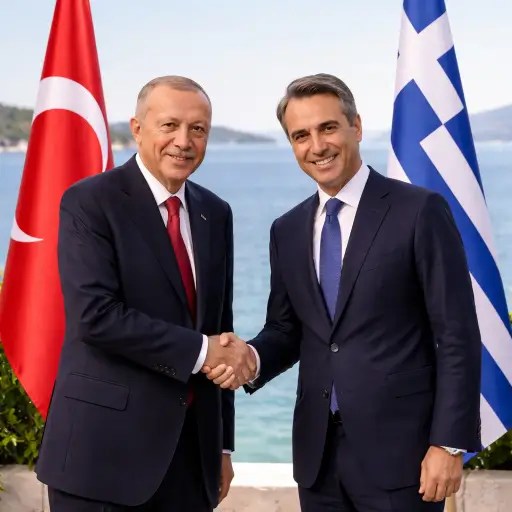
Turkey and Greece signal potential easing of long-running war threat as leaders express cautious optimism over maritime disputes and regional tensions

In a carefully choreographed diplomatic encounter that is resonating well beyond the shores of the Aegean, Turkey and Greece have signaled what may become the most meaningful easing of tensions between the two NATO allies in decades, reviving cautious optimism that entrenched disputes long defined by threats, airspace violations and naval brinkmanship could gradually give way to structured dialogue.
The meeting between Turkish President Recep Tayyip Erdoğan and Greek Prime Minister Kyriakos Mitsotakis has injected new momentum into relations that for years have been overshadowed by a standing declaration from Turkey’s parliament describing any unilateral extension of Greek territorial waters in the Aegean as grounds for war, a threat dating back decades and widely regarded in Athens as the most combustible element in an already fragile relationship.
Speaking after their latest round of talks, both leaders emphasized the need to reduce inflammatory rhetoric and restore a measure of trust, with Mitsotakis reiterating Greece’s long-standing position that differences over maritime zones must be resolved peacefully and, if necessary, through international adjudication, while urging the removal of what Greece considers an anachronistic war threat incompatible with regional stability and the spirit of alliance within NATO.
Erdoğan, while reaffirming Turkey’s core interests in the Aegean and Eastern Mediterranean, adopted a notably measured tone and stressed that dialogue does not imply concession but acknowledged that sustained confrontation serves neither nation’s economic nor security interests, remarking that neighbors must ultimately find ways to coexist despite profound disagreements.
The Aegean has long served as a theater of symbolic and strategic rivalry, where competing interpretations of maritime law, overlapping claims to continental shelves and disputes over the militarization of certain islands have periodically brought the two countries to the brink, with military jets intercepting one another over contested airspace and naval vessels shadowing rival exploration ships in tense standoffs.
Yet the regional landscape has shifted in recent years as energy geopolitics, migration pressures and the shared trauma of natural disasters have underscored the tangible costs of perpetual hostility, with devastating earthquakes and wildfires prompting reciprocal gestures of solidarity that quietly reopened diplomatic channels and revived memories of earlier periods of so-called earthquake diplomacy.
As part of the renewed engagement, Ankara and Athens signed cooperation agreements spanning trade facilitation, disaster response coordination, tourism promotion and scientific exchange, modest in scope when measured against the magnitude of their disputes but designed to institutionalize contact at multiple levels of government and civil society and reduce the risk of sudden escalation.
Diplomats on both sides describe the approach as incremental and pragmatic, focused on building confidence in less contentious areas while keeping open channels on the most sensitive files, including Cyprus, whose unresolved division continues to shape strategic calculations in both capitals and remains inseparable from broader questions of sovereignty and maritime rights in the Eastern Mediterranean.
European officials have quietly welcomed the latest developments, noting that stability between Turkey and Greece carries implications for migration management, energy transit routes and NATO’s southern flank at a time when geopolitical strains elsewhere demand attention and leave little appetite for renewed crisis in the Aegean.
Skepticism nonetheless endures among analysts who caution that previous rapprochements have faltered under the weight of domestic politics and sudden incidents at sea or in the air, with nationalist constituencies in both countries remaining wary of compromise and quick to interpret tactical flexibility as strategic retreat.
What distinguishes the current moment, according to regional observers, is a shared recognition of economic interdependence and strategic fatigue, as inflationary pressures and reconstruction costs sharpen incentives to prioritize stability while business communities in Istanbul and Athens press for predictability and the tourism sector depends heavily on the perception of calm.
Behind closed doors, diplomats are exploring technical mechanisms for de-escalation including clearer communication channels between military commands, expanded confidence-building measures and the possibility of structured talks on maritime delimitation, steps that may appear procedural yet could prove decisive in preventing misunderstandings from spiraling into confrontation.
Whether this moment marks a durable turning point or another temporary lull remains uncertain, but the tone emanating from Ankara and Athens suggests an awareness that the status quo is unsustainable and that the long shadow of a formalized war threat has become increasingly out of step with contemporary strategic realities.
In the waters of the Aegean, where geography has long intertwined the destinies of two proud nations, even incremental progress carries symbolic weight, and if sustained the current dialogue could gradually transform a legacy of threat into a model of managed coexistence and demonstrate that rivalry need not preclude reconciliation.