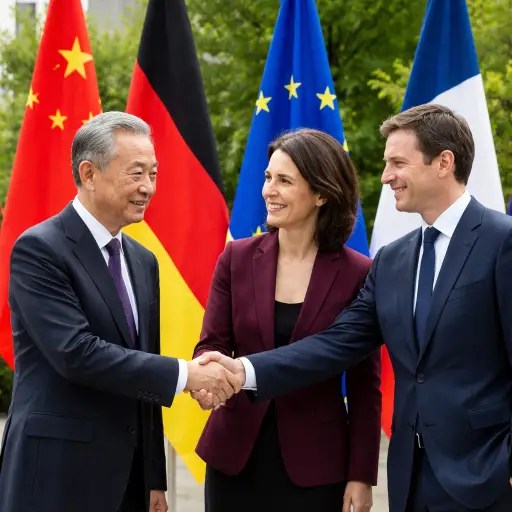
Beijing seeks to reset ties with Berlin and Paris in a landmark trilateral meeting, signaling a strategic push for cooperation over competition
In a carefully staged diplomatic overture that reflects the shifting balance of global power, China’s foreign minister told his counterparts from Germany and France that Beijing regards Europe as a partner in cooperation rather than a strategic rival, a message delivered during a rare trilateral meeting that signals a renewed attempt to stabilize relations at a time of heightened geopolitical uncertainty.
The unprecedented format of the talks, bringing together senior officials from Beijing, Berlin and Paris, underscored China’s intention to engage directly with the European Union’s two most influential capitals as the continent reassesses its economic dependencies and strategic posture in an increasingly fragmented world order.
Speaking in measured but deliberate terms, the Chinese foreign minister emphasized that China and Europe share broad common interests in trade, climate action and multilateral governance, urging both sides to resist what he described as bloc confrontation and instead deepen pragmatic cooperation in areas of mutual benefit.
The meeting comes amid a period of recalibration in Europe’s China policy, as Brussels continues to describe Beijing simultaneously as a partner, competitor and systemic rival, language that reflects both the depth of economic ties and the growing unease over industrial competition, market access and security concerns.
Trade remains central to the relationship, with the European Union ranking among China’s largest export markets while European manufacturers depend heavily on Chinese supply chains and consumer demand, yet tensions over electric vehicles, state subsidies and strategic technologies have fueled calls within Europe for so‑called de‑risking rather than outright decoupling.
By engaging Germany and France in a trilateral setting, Beijing appears to be seeking influence over how that de‑risking strategy evolves, reminding policymakers that decades of economic integration have generated shared prosperity and that abrupt disruption would carry significant costs for both sides.
Climate cooperation featured prominently in the discussions, as China and Europe, both major emitters with ambitious carbon neutrality targets, explored avenues for joint initiatives in renewable energy, green finance and emissions reduction frameworks that could serve as stabilizing pillars within a broader and sometimes strained partnership.
Analysts say the outreach reflects Beijing’s broader effort to reposition itself as a stabilizing global actor amid shifting alliances and intensifying great‑power rivalry, particularly as transatlantic relations face periodic friction over industrial policy and defense commitments and emerging economies assert greater influence in international institutions.
For Germany and France, the diplomatic calculus remains complex, balancing domestic political pressures and strategic caution with the recognition that economic disengagement from China is neither simple nor necessarily desirable, especially given the depth of commercial investment spanning automotive manufacturing, aviation, energy and high‑end consumer goods.
European officials have repeatedly stressed that any durable partnership must be grounded in reciprocity, transparency and adherence to international norms, pointing to unresolved concerns ranging from market barriers to cybersecurity and Beijing’s geopolitical alignments, issues that continue to test the resilience of the relationship.
Still, the symbolism of three major powers sitting at one table to emphasize dialogue over division carries weight in a global climate marked by conflict and fragmentation, offering at least a temporary reprieve from confrontational rhetoric and suggesting space for diplomatic maneuver.
Whether the conciliatory tone translates into substantive policy shifts will depend on concrete follow‑through, including measurable progress on market access and fair competition, but for now China’s message to Europe is unmistakable: in a turbulent international environment, cooperation is preferable to confrontation, and partnership remains both possible and strategically necessary.
 The Tower Post