Breakthrough in Brussels brings sweeping tariff cuts within reach as agriculture remains final hurdle

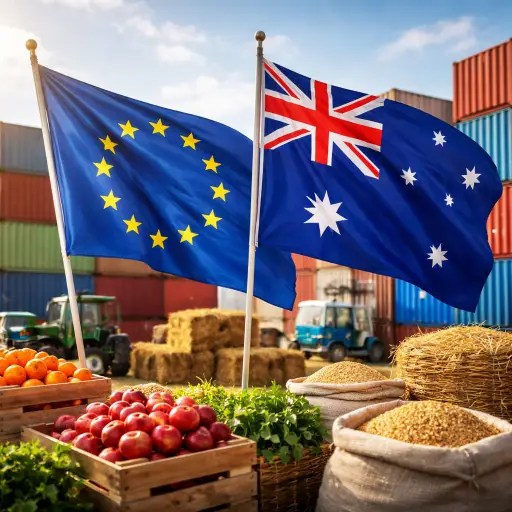
Negotiators from the European Union and Australia have reported decisive progress toward a long-anticipated free-trade agreement, raising expectations that a politically sensitive pact once considered stalled may finally be within reach.
Officials close to the talks described the latest round in Brussels as the most productive in years, with substantial convergence across core chapters of the agreement and renewed political momentum on both sides.
The proposed deal would dismantle tariffs on a wide range of goods, streamline customs procedures, and reduce regulatory friction between the EU’s single market and Australia’s export-oriented economy, creating new commercial opportunities across continents.
European manufacturers, particularly in the automotive and industrial machinery sectors, stand to benefit from improved access to Australian markets, while Canberra is seeking broader entry for its agricultural exports including beef, lamb, dairy, and wine.
Diplomats involved in the discussions say the atmosphere has shifted from caution to guarded optimism, reflecting a narrowing of differences that had previously slowed negotiations and fueled doubts about the agreement’s viability.
Agriculture remains the most delicate and politically charged issue, with European farming groups voicing concern about increased imports and potential downward pressure on domestic prices in an already competitive environment.
Australia has consistently argued that expanded agricultural access is essential for the deal’s economic balance, maintaining that its producers meet high standards of sustainability and animal welfare that align with European expectations.
Negotiators are exploring compromise solutions that could include phased tariff reductions, calibrated quota expansions, and safeguard clauses designed to protect sensitive sectors in the event of sudden market disruptions.
Beyond the immediate commercial gains, the agreement carries significant strategic implications as both partners seek to reinforce economic ties among advanced democracies amid global supply chain uncertainty and shifting geopolitical dynamics.
For the European Union, deeper engagement with Australia strengthens its broader Indo-Pacific strategy and diversifies trade partnerships in a region of growing economic and political importance.
For Australia, closer integration with Europe complements its existing trade framework and reduces dependence on any single export destination, reinforcing resilience in an increasingly volatile global trading system.
Talks have also advanced on environmental and labor provisions, areas that have become central to modern trade agreements and are likely to face close scrutiny during the ratification process in European capitals.
European policymakers insist that sustainability commitments must align with climate objectives and international labor standards, while Australian representatives have signaled readiness to craft mutually acceptable language without compromising domestic regulatory autonomy.
Business leaders on both sides have welcomed the reported progress, emphasizing that clearer rules on digital trade, public procurement, and intellectual property would provide certainty for investors and exporters alike.
Although officials caution that nothing is final until every chapter is agreed, the tone emerging from Brussels suggests that negotiators are now working through technical details rather than confronting fundamental divides.
After years of intermittent pauses and political headwinds, the prospect of a comprehensive EU-Australia free-trade accord appears closer than at any point in recent memory.
The remaining challenge lies in translating technical convergence into political consensus, as leaders weigh domestic sensitivities against the broader economic and strategic gains the agreement promises to deliver.
For now, both sides appear determined to seize the moment, signaling that a deal once viewed as elusive may soon become a defining milestone in transcontinental economic cooperation.