At the Munich Security Conference, the U.S. Secretary of State affirms that Washington and Europe belong together even as policy rifts and calls for European self-reliance shape a changing alliance.

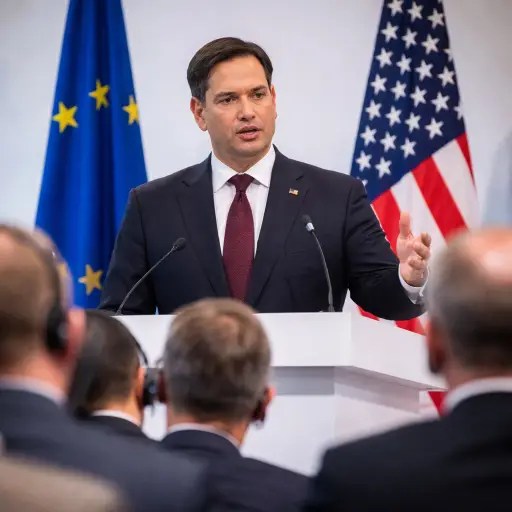
In a hall charged with strategic unease and diplomatic anticipation, U.S. Secretary of State Marco Rubio delivered a message many European officials had been hoping to hear: the United States remains firmly committed to its partnership with Europe at a time of mounting global uncertainty.
Addressing the Munich Security Conference, Rubio declared that Washington and Europe belong together in confronting the defining challenges of the present era, from ongoing war on the European continent to instability in the Middle East and intensifying geopolitical competition worldwide.
The speech, closely watched across European capitals, was designed to steady nerves about the durability of transatlantic ties and to underscore that despite shifting political winds and policy debates, the strategic logic binding the United States and Europe endures.
When America and Europe stand together, Rubio said, they help shape the international order; when they drift apart, adversaries exploit the gap, a formulation that drew sustained attention from an audience keenly aware of the stakes involved.
Central to his remarks was a renewed commitment to collective defence within NATO, which he described as the cornerstone of deterrence and stability, reaffirming that American support for the alliance remains resolute even as Washington urges continued burden-sharing and modernization among European allies.
Rubio praised recent increases in European defence spending and efforts to strengthen military readiness, calling them evidence that the alliance is adapting to new security realities rather than resting on past assumptions.
Yet reassurance was paired with candor, as the Secretary acknowledged persistent differences over climate policy, trade rules and the future of multilateral institutions, signaling that transatlantic unity does not eliminate legitimate divergence between sovereign democracies.
On climate and energy, Rubio emphasized a U.S. approach that prioritizes energy security and industrial competitiveness, while European governments continue to pursue ambitious regulatory frameworks aimed at accelerating decarbonization, a contrast that has occasionally translated into economic friction.
Trade tensions were addressed directly, with Rubio arguing that strategic competition in a fragmented global economy requires safeguarding critical industries, even as he stressed that disputes within the alliance must remain manageable and secondary to shared geopolitical objectives.
The question of multilateral institutions also surfaced, as Washington advocates reform and greater efficiency while many European leaders defend existing structures as stabilizing pillars of the postwar order, revealing subtle differences in emphasis rather than outright disagreement.
European responses combined appreciation with resolve, as officials welcomed the affirmation of solidarity but reiterated the necessity for Europe to become more self-reliant and geopolitically assertive in an era defined by uncertainty.
German representatives pointed to expanded defence initiatives and deeper cooperation within the European Union, while French officials renewed calls for strategic autonomy, insisting that a stronger Europe would ultimately reinforce rather than weaken the transatlantic bond.
Leaders from Central and Eastern Europe underscored that greater European capability complements American leadership within NATO, particularly in safeguarding the alliance’s eastern flank and sustaining support for Ukraine’s sovereignty.
In private discussions on the conference sidelines, diplomats described a relationship that is stable yet evolving, grounded in shared values but increasingly shaped by pragmatic calculations about capabilities, competitiveness and long-term resilience.
Rubio appeared sensitive to that recalibration, welcoming Europe’s push for greater defence capacity as a positive development and framing the alliance not as a hierarchy but as a partnership adapting to shifting balances of power.
Beyond immediate security concerns, conversations in Munich ranged across technological rivalry, supply chain resilience, migration pressures and the rise of influential middle powers, all of which reinforce the need for coordinated transatlantic responses.
The symbolism of Rubio’s presence at the conference was itself significant, signaling continuity in engagement and offering a clear articulation of American commitment at a moment when predictability carries strategic weight.
Still, European leaders made clear that reassurance does not translate into complacency, as governments across the continent accelerate efforts to strengthen industrial capacity, diversify energy sources and deepen defence integration.
The alliance that emerged from the conference is neither nostalgic nor transactional alone, but a partnership under adjustment, defined less by sentiment than by a sober recognition of shared interests in a more contested world.
As discussions concluded, one message resonated strongly through Munich’s corridors: Washington and Europe continue to see their futures as intertwined, even as both sides prepare to shoulder greater responsibility in shaping the global landscape.