New Delhi gathering signals a new era of cross-border collaboration, policy debate and investment momentum in artificial intelligence

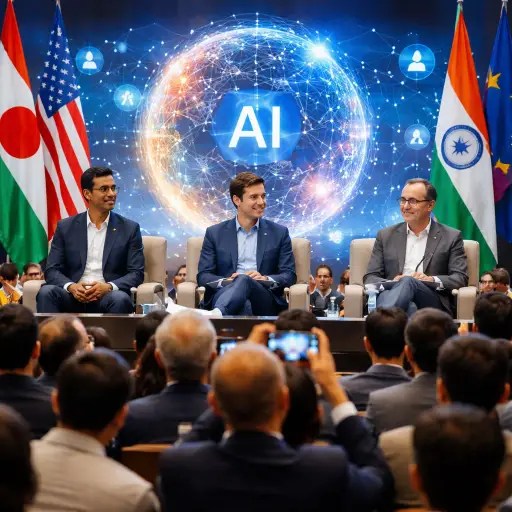
The world’s most influential figures in artificial intelligence have gathered in India’s capital for the India AI Impact Summit, transforming the city into a focal point of global technological diplomacy and economic ambition. Executives at the helm of the AI revolution, including Sundar Pichai of Google, Sam Altman of OpenAI and Demis Hassabis of Google DeepMind, are meeting alongside policymakers, investors and researchers in a summit that reflects both the promise and the pressure surrounding one of the most consequential technologies of the modern era.
The summit unfolds at a moment when artificial intelligence is reshaping industries at a pace that few governments or corporations can afford to ignore. From generative systems capable of drafting legal briefs and producing cinematic content to predictive models guiding healthcare diagnostics and climate simulations, AI has moved decisively from research laboratories into the fabric of everyday economic life. The concentration of leadership in New Delhi underscores a shared understanding that the next chapter of AI development will be defined not only by code and computing power, but by international cooperation and strategic alignment.
Organisers describe the gathering as an impact-driven forum designed to bridge advanced research with scalable deployment across diverse economies. India’s vast digital public infrastructure, expanding startup ecosystem and deep reservoir of engineering talent have positioned it as both a proving ground and a launchpad for AI applications aimed at emerging markets. By hosting this summit, India signals its intention to play a central role in shaping global standards rather than merely adopting them.
Behind the formal speeches and public panels, closed-door sessions are focused on harmonising regulatory frameworks that are rapidly diverging across regions. Executives and ministers are grappling with how to align data governance rules, safety testing protocols and intellectual property standards in a landscape where fragmented policies could stifle innovation or create regulatory arbitrage. The conversations reflect a growing recognition that AI systems, by their nature, operate across borders even when laws do not.
A key theme running through the discussions is the balance between competitiveness and collaboration. Nations view AI as a strategic asset capable of enhancing productivity, military capability and geopolitical influence, yet the technology’s risks, from misinformation to systemic bias, demand shared safeguards. Participants are exploring the contours of multilateral research partnerships and voluntary safety commitments intended to prevent a race to the bottom in standards.
The summit’s economic dimension is equally striking. Organisers project that partnership announcements and investment pledges could collectively approach one hundred billion dollars in value, a figure that would represent a substantial deepening of international capital engagement in AI infrastructure and applications. While such projections are inherently aspirational, analysts note that the appetite for long-term AI investment remains robust despite broader global economic uncertainty.
Venture capital firms and sovereign funds are evaluating opportunities spanning semiconductor design, cloud computing infrastructure, enterprise automation platforms and multilingual generative models tailored to diverse populations. India’s domestic market, characterised by rapid digital adoption and a complex tapestry of languages and consumer segments, offers fertile terrain for AI services capable of operating at scale. For international companies, partnerships forged here may provide access to both talent and transformative use cases.
Yet optimism is tempered by unresolved ethical and societal questions. Panels throughout the summit address the environmental footprint of energy-intensive data centers, the displacement of workers in routine knowledge roles and the challenge of building datasets that reflect global diversity rather than narrow cultural perspectives. Civil society advocates are urging greater transparency in model training and clearer accountability when AI systems produce harmful outcomes.
Speakers repeatedly emphasise that trust will determine the trajectory of adoption. Without credible safeguards and inclusive governance, public confidence could erode, slowing the integration of AI into critical sectors such as healthcare, finance and public administration. The summit’s framing around impact suggests that commercial success alone will not suffice; measurable societal benefit has become a parallel benchmark for legitimacy.
For India, the event carries symbolic as well as practical weight. The country has invested heavily in digital identity systems, payment networks and broadband expansion, laying a foundation upon which AI-driven services can proliferate. Universities are expanding advanced research programs, and startups are forging alliances with global technology firms, reinforcing a narrative of India as both innovator and integrator in the AI ecosystem.
The convergence of Western technology leaders, Asian policymakers and investors from multiple continents highlights India’s emerging role as a bridge between advanced economies and developing markets. By convening diverse stakeholders under one roof, the summit projects an image of cooperative ambition at a time when technological competition often dominates headlines. It also reinforces the notion that AI governance will require voices from beyond traditional power centers.
Observers note that the significance of the summit may ultimately lie less in headline investment totals than in the frameworks and relationships established here. Agreements on joint research labs, shared testing benchmarks and collaborative data initiatives could shape the contours of global AI governance for years to come. In an era defined by rapid technological acceleration, the willingness of leaders to gather, debate and coordinate may prove as consequential as any single breakthrough model.
As deliberations continue in New Delhi, the atmosphere blends enthusiasm with gravity. Artificial intelligence promises to redefine productivity and creativity, yet it also compels societies to confront profound questions about control, equity and responsibility. The India AI Impact Summit stands as a vivid reminder that the future of AI will be forged not in isolation, but through negotiation, partnership and a shared commitment to shaping technology in service of a broader human agenda.