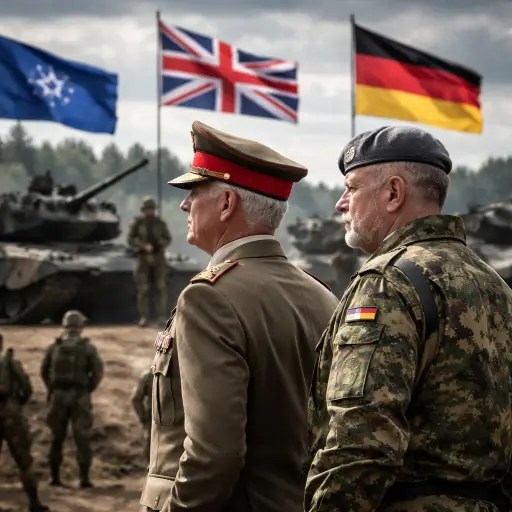
A rare joint appeal frames defence renewal as a moral duty amid mounting geopolitical uncertainty

In an unusually direct appeal to the public, the heads of the British and German armed forces have urged citizens to support a renewed push for military rearmament, describing stronger defence capabilities as both a strategic necessity and a moral responsibility in an increasingly volatile global landscape.
Through coordinated statements amplified across allied channels, the senior commanders warned that Europe can no longer rely on the assumption that decades of relative stability will endure without sustained investment in deterrence and readiness.
Their intervention marks a notable shift in tone within European civil-military relations, where top officers have traditionally maintained distance from overt public advocacy on budgetary and political questions.
The message emerging from London and Berlin is clear: national readiness is not an abstract doctrine confined to planning rooms but a lived responsibility that demands consistent political will and public backing.
Both chiefs pointed to the persistence of high-intensity conflict on Europe’s periphery, the rapid militarisation of advanced technologies, and the erosion of established security norms as evidence that the strategic environment has fundamentally changed.
What distinguishes this appeal is its ethical framing, as the commanders presented rearmament not merely as a calculation of force ratios but as a moral obligation to defend democratic societies, protect allies, and deter aggression before it escalates into wider confrontation.
They argued that credible deterrence reduces the likelihood of war by signalling preparedness and resolve, whereas prolonged underinvestment risks inviting miscalculation by actors who interpret hesitation as weakness.
Across Europe, debates over defence spending have intensified as governments balance fiscal pressures, social commitments, and the need to modernise armed forces that were scaled back in the post-Cold War era.
Britain continues to position itself as a leading European military power with expeditionary capabilities and a nuclear deterrent, while Germany has undergone a profound reassessment of its security posture after decades of restraint rooted in its post-war history.
Berlin’s policy shift toward higher defence investment signalled a historic turning point, and the joint appeal underscores how deeply that reassessment has reshaped Germany’s strategic outlook.
The commanders stressed that rearmament is not solely about allocating larger budgets but about modernising equipment, rebuilding ammunition stockpiles, strengthening cyber and space capabilities, and ensuring that supply chains are resilient in times of crisis.
They also emphasised the need for transparency and democratic oversight, acknowledging that sustained defence investment in open societies requires public trust and political continuity.
Public opinion remains divided as households confront inflationary pressures, energy transitions, and competing demands on national budgets, making defence spending a more visible and contested issue than at any point in recent memory.
Supporters of the renewed push argue that credible defence underpins economic stability and social progress, while critics caution that heightened rhetoric and accelerated procurement could divert resources from urgent domestic priorities.
At the centre of the discussion lies NATO’s evolving role, with alliance members reassessing force structures, interoperability standards, and the balance of responsibility between North America and Europe.
By presenting a united front, Britain and Germany signal a determination to strengthen the European pillar of the alliance while maintaining transatlantic cohesion in an era of strategic uncertainty.
Defence industry leaders are watching closely, as expanded procurement plans carry implications for production capacity, innovation cycles, and long-term industrial strategy across the continent.
Military planners increasingly highlight rapid deployment forces, integrated air and missile defence systems, and next-generation technologies such as autonomous platforms as priorities for investment.
The appeal from the two chiefs ultimately reflects a broader transformation in Europe’s security conversation, as issues once confined to specialist circles now occupy the centre of public debate.
Whether citizens embrace the argument that rearmament is a moral and strategic imperative remains uncertain, but the intervention makes clear that Europe’s military leadership believes the moment demands candor, urgency, and collective resolve.