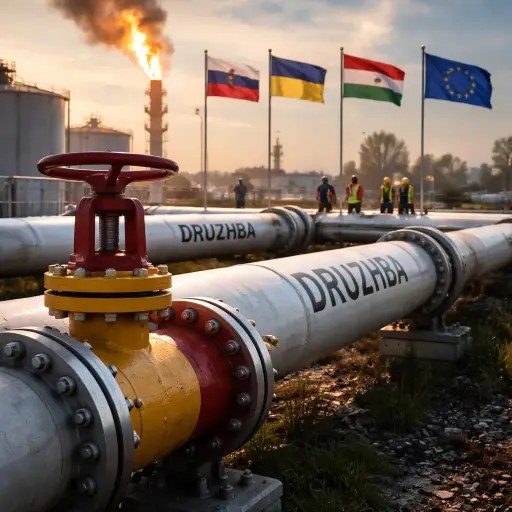
Slovak Prime Minister Robert Fico accuses Ukraine of stalling oil flows to pressure Hungary, underscoring how infrastructure has become a geopolitical lever across the European Union.
As winter grips Central Europe, the Druzhba oil pipeline has once again emerged as a geopolitical flashpoint, exposing how deeply energy security and political strategy remain intertwined across the continent.
Slovak Prime Minister Robert Fico has accused Ukraine of delaying the restart of crude transit through a key branch of the pipeline that supplies Slovakia and Hungary, suggesting the move is intended to pressure Budapest over its stance within the European Union.
Ukrainian officials have rejected the allegation, insisting that any delays are tied to operational safety assessments and infrastructure protection measures undertaken in the context of ongoing war conditions rather than political leverage.
The renewed dispute illustrates how infrastructure built decades ago under a different geopolitical order continues to shape today’s diplomatic tensions, with pipelines functioning not only as commercial arteries but also as instruments of influence.
The Druzhba network, constructed during the Soviet era, still carries significant volumes of Russian crude into landlocked EU member states that have struggled to fully diversify their supply routes despite concerted efforts since the invasion of Ukraine.
Hungary under Prime Minister Viktor Orbán has frequently diverged from broader EU policy on sanctions and energy relations with Moscow, arguing that rapid disengagement would inflict severe economic consequences on Hungarian households and industry.
Slovakia finds itself navigating a delicate position, aligned with European policy yet acutely sensitive to domestic economic pressures tied to refinery operations, fuel pricing, and industrial competitiveness that depend on reliable pipeline flows.
Energy analysts note that Ukraine’s role has evolved from that of a passive transit corridor to a strategic gatekeeper, granting Kyiv leverage over infrastructure that remains critical to parts of Central Europe while also exposing it to political scrutiny.
For Brussels, the disagreement presents another cohesion test as European officials work to preserve unity on sanctions and financial support for Ukraine while mediating tensions between member states facing immediate energy concerns.
Market reaction has remained cautious rather than alarmed, reflecting expectations that a complete and prolonged shutdown is unlikely, yet traders continue to monitor developments closely because even short disruptions can influence regional pricing and refinery margins.
Behind the rhetoric, technical negotiations over maintenance schedules, transit conditions, and contractual guarantees are likely to determine whether flows normalize, as pipeline disputes are typically resolved through quiet diplomacy rather than public confrontation.
The episode also underscores the structural limits of Europe’s diversification drive, since adapting refineries to process alternative crude grades requires time and investment, leaving certain economies temporarily exposed despite long-term strategic planning.
For consumers in Slovakia and Hungary, the implications translate into fuel costs and economic stability, while for Ukraine the management of transit routes forms part of a broader balancing act between safeguarding national security and sustaining European solidarity.
As discussions continue behind closed doors, the future of Druzhba’s operations will signal more than the movement of oil, offering a measure of whether pragmatic compromise can prevail over political friction in an increasingly fragmented energy landscape.




 The Tower Post