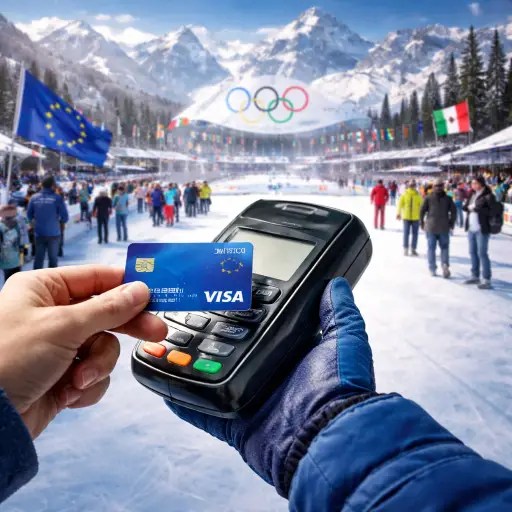
At the Milano-Cortina Winter Games, the global card giant’s exclusive grip on transactions revives questions over EU economic sovereignty, digital dependence, and the fading role of cash

As winter sport commands global attention across Italy’s alpine venues, a quieter but consequential reality is unfolding beyond the slopes and arenas, where every tap at food counters, merchandise stands and hospitality lounges routes through a single dominant payment network.
Under its long-standing global sponsorship agreement with the International Olympic Committee, Visa holds exclusive rights as the official payment services partner of the Games, meaning that electronic transactions inside official venues rely on Visa’s infrastructure.
For spectators the system feels seamless and routine, but for policymakers in Brussels the arrangement offers a vivid demonstration of a structural imbalance that has become harder to ignore as Europe moves deeper into a cash-light economy.
The European Union hosts one of the world’s largest consumer markets, yet its retail payments ecosystem depends heavily on non-European card schemes, with Visa and Mastercard processing a significant share of transactions across the bloc.
While several member states maintain domestic card systems, few operate at continental scale and none rival the global reach and network effects of the American giants, a disparity that becomes especially visible during high-profile international events staged on European soil.
The Olympic spotlight transforms what might otherwise be a technical matter into a symbolic one: a flagship European sporting celebration mediated financially by infrastructure headquartered outside the continent.
In recent years the European Commission has increasingly framed economic policy around the concept of strategic autonomy, a term encompassing energy security, digital infrastructure, defense capabilities and supply chain resilience, and payments now sit firmly within that conversation.
Control over payment systems influences not only transaction processing but also data governance, cybersecurity standards, sanctions compliance and systemic stability, all of which acquire greater weight as digital transactions replace physical cash.
The European Central Bank has repeatedly warned that declining cash usage risks narrowing citizens’ access to central bank money, effectively shifting day-to-day commerce onto private digital networks whose governance lies beyond direct public control.
At the Games, cash acceptance is limited in practice as vendors prioritize contactless efficiency and visitors expect frictionless mobile payments, reinforcing broader consumer habits that have accelerated since the pandemic years.
The more commerce migrates to digital channels, the more strategically important the underlying networks become, since they generate valuable economic data and form part of the critical infrastructure supporting retail trade and tourism flows.
For small merchants operating within the Olympic footprint, exclusivity agreements reduce choice and concentrate acceptance conditions within a single framework, altering competitive dynamics that would otherwise exist between rival card schemes.
None of this suggests operational failure, as Visa’s network processes transactions rapidly and securely, but the policy question extends beyond performance to the broader issue of who ultimately anchors Europe’s digital payment rails.
The debate feeds directly into ongoing discussions about a potential digital euro, which supporters argue would preserve monetary sovereignty by ensuring that Europeans retain access to a public form of digital money alongside private solutions.
Critics of the digital euro caution against costs, privacy concerns and unintended consequences for commercial banks, yet the imagery of exclusive foreign payment dominance at a continental mega-event strengthens the hand of those advocating for a stronger public or homegrown alternative.
Parallel industry efforts such as the European Payments Initiative aim to build a unified pan-European card and digital wallet solution capable of competing with global incumbents, but progress has been gradual amid fragmented markets and entrenched consumer preferences.
Europe’s regulatory environment, including open banking rules and updated payment services legislation, has fostered fintech innovation, yet scale remains elusive compared with networks that have spent decades building cross-border merchant acceptance and brand recognition.
The Olympic case therefore crystallizes a broader industrial dilemma facing the EU: whether to accept reliance on established global champions or invest more aggressively in cultivating indigenous capacity in strategically sensitive sectors.
Transatlantic financial ties remain deep and cooperative, and the issue is not framed as a confrontation, but shifting geopolitical realities have made policymakers more attentive to dependencies that once seemed benign.
As medals are awarded and visitors depart, few will reflect on the infrastructure behind their souvenir purchases, yet the Games will have served as a live demonstration of how everyday transactions intersect with questions of sovereignty and resilience.
In the end, the Milano-Cortina Winter Games have delivered athletic drama and economic stimulus, but they have also illuminated a subtler contest over control of the digital arteries through which Europe’s modern economy increasingly flows.
Whether the EU chooses regulatory fine-tuning, public digital currency, industrial coordination or some combination of all three, the Olympic experience underscores that payments are no longer merely technical plumbing but a strategic domain shaping Europe’s economic future.


 The Tower Post