A robotics engineer turned designer merges code and couture, unveiling an interactive garment that opens like a living flower and redefines who belongs in both fashion and STEM.

New York’s fashion scene thrives on spectacle, but this season’s most arresting debut did not rely on sequins or shock value; it breathed, responding to the energy of the room in a way that felt both intimate and revolutionary.
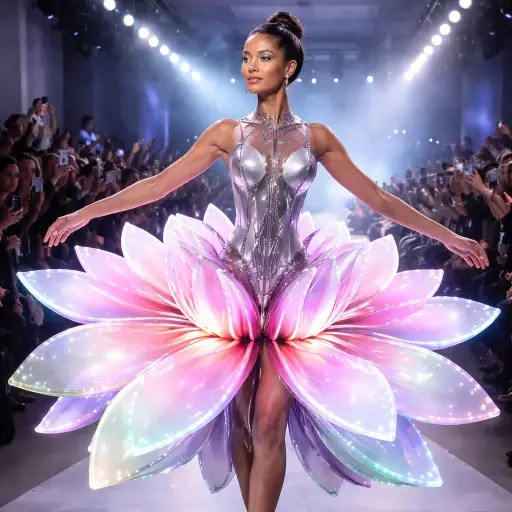
Inside a packed venue pulsing with anticipation, a model stepped onto the runway wrapped in a sculptural evening gown composed of layered, iridescent petal-like panels that shimmered softly under the lights, elegant and architectural in stillness.
Then someone in the front row leaned forward and raised a hand, and the dress responded.
Petals unfurled in a slow, fluid motion, blooming outward as if awakened by sunlight, drawing an audible wave of gasps from editors, buyers, technologists, and students who moments earlier had been poised behind their screens.
The “Blooming Dress,” created by a robotics engineer who transitioned from laboratories to ateliers, has quickly become the defining image of this New York Fashion Week, embodying a seamless fusion of responsive technology and high fashion.
Beneath the silk organza exterior lies a hidden system of lightweight actuators, embedded microcontrollers, and proximity sensors that detect movement and trigger a precisely choreographed expansion of the garment’s sculptural structure.
Unlike earlier experiments in wearable technology that foregrounded circuitry and spectacle, this design conceals its engineering within soft, biomimetic construction, replacing rigid frames with flexible supports and traditional wiring with conductive threads woven directly into the fabric.
The result is not a technological accessory stitched onto a dress but a fully integrated work in which engineering and artistry function as one, producing movement that feels organic rather than mechanical.
The symbolism is intentional, reframing the flower not as passive decoration but as an active force that reacts, expands, and claims space in response to human presence.
“For so long, women in technology have been expected to shrink themselves to fit the room,” the designer said backstage after the show, explaining that the garment’s expanding silhouette represents a refusal to contract in environments that underestimate female expertise.
As the model moved down the runway, each interaction generated a slightly different bloom, reinforcing the idea that fashion need not be static but can exist as a living dialogue between garment and audience.
The development process demanded months of collaboration across disciplines, bringing engineers together with pattern makers, coders alongside seamstresses, and requiring dozens of failed prototypes before the motion achieved its current seamless grace.
Early iterations overheated or opened too abruptly, disrupting the illusion of natural growth, and fine-tuning the choreography between software and fabric proved as essential as selecting the precise iridescent hue that now catches the light.
Industry observers say the Blooming Dress marks a turning point in wearable innovation by situating advanced robotics within the established language of couture rather than positioning technology as a novelty detached from tradition.
The debut also carried cultural weight beyond aesthetics, as the presence of a woman with a robotics background commanding one of fashion’s most visible stages challenged persistent stereotypes about who belongs in STEM fields and creative industries alike.
Among the invited guests were young engineering students attending as part of a diversity initiative, many of whom described the show as a powerful affirmation that analytical rigor and artistic expression are not mutually exclusive paths.
By embedding robotics within a traditionally feminine medium, the designer dismantles the outdated binary separating technical mastery from aesthetic sensitivity, demonstrating that code can be poetic and that poetry can be programmable.
Sustainability considerations further underpin the concept, as the responsive components are modular and designed for replacement or upgrade, extending the garment’s lifespan and suggesting a future in which technology supports longevity rather than disposability.
Critics are already speculating about broader applications, from performance costumes that react to music in real time to adaptive garments capable of adjusting structure in response to environmental conditions or accessibility needs.
Yet for now, the Blooming Dress stands less as a commercial prototype and more as a cultural statement, inviting the industry to imagine clothing not as static objects but as collaborators that engage with the world around them.
As the finale concluded and the lights softened, one final gesture from the crowd triggered a full bloom, the petals arcing outward in a luminous halo that briefly blurred the boundary between machine and nature.
In a week defined by reinvention, the Blooming Dress offered something rarer than spectacle: a new vocabulary for fashion in which engineering is intimate, innovation is elegant, and women in STEM are not anomalies but architects of the aesthetic future.
When the petals finally folded back into sculptural calm, the applause felt less like a reaction to a single garment and more like recognition that an idea had taken root and opened before the world’s eyes.