Brussels highlights deepening transatlantic ties as Canada gains invite to key EU economic talks

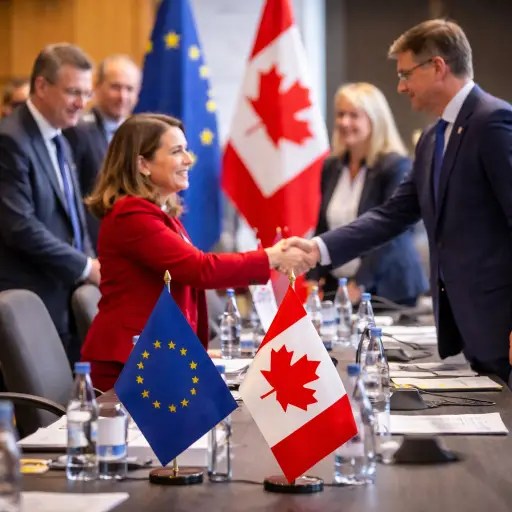
Brussels has extended a formal invitation to Canada to participate in an upcoming gathering of European Union economic ministers, a move widely interpreted as a signal of strengthening transatlantic alignment at a moment of geopolitical and commercial uncertainty. The invitation elevates Ottawa’s presence in discussions that help shape the bloc’s economic direction and regulatory outlook, reinforcing the sense that cooperation among advanced democracies is entering a more structured phase.
The decision comes as European policymakers seek to reinforce ties with like-minded partners amid persistent market volatility and strategic competition across key industries. By welcoming Canada into a forum traditionally reserved for member states, the European Union is projecting openness while maintaining its institutional framework, signaling that collaboration can expand without compromising internal decision-making authority.
Diplomats in Brussels describe the invitation as both practical and symbolic. On a practical level, Canada’s diversified economy and extensive trade links with Europe make it a natural contributor to debates on supply chain resilience, digital transformation, and the green transition. Symbolically, the gesture underscores a shared commitment to rules-based trade and coordinated responses to global economic challenges.
For Canada, the opportunity represents a diplomatic milestone. Ottawa has steadily pursued a strategy aimed at diversifying trade relationships and strengthening engagement with Europe, viewing the partnership as a stabilizing counterweight in a rapidly shifting global landscape. Participation in high-level EU economic discussions offers Canada a platform to engage directly with regulatory initiatives that increasingly carry global implications.
The foundation for deeper cooperation was laid through the Comprehensive Economic and Trade Agreement, which significantly expanded trade and investment flows between the two sides. While that framework focused primarily on reducing barriers, officials now speak of advancing toward closer regulatory alignment, joint innovation strategies, and coordinated approaches to industrial policy in emerging sectors.
European officials argue that closer coordination with Canada supports the bloc’s broader economic security agenda. As the EU reassesses dependencies in areas such as critical raw materials, advanced technologies, and energy systems, collaboration with trusted partners has become a cornerstone of policy. Canada’s resource base and technological expertise align closely with European ambitions to build diversified and sustainable supply chains.
The timing of the invitation carries particular weight as global economic conditions remain unsettled. Inflationary pressures, evolving energy dynamics, and competition over state support for strategic industries continue to test established alliances. Against this backdrop, the EU appears determined to demonstrate that it can convene partners in pursuit of cooperative solutions rather than fragmented approaches.
Canadian officials have welcomed the development, emphasizing the alignment of priorities in climate policy, digital governance, and sustainable investment. Ottawa’s domestic focus on clean technology and responsible resource development resonates with the European Green Deal and related initiatives aimed at accelerating decarbonization while preserving competitiveness.
Analysts suggest that Canada’s participation could contribute to bridging broader transatlantic policy debates. Differences in regulatory philosophies and subsidy frameworks have occasionally strained relations among Western economies, but structured ministerial dialogue may help narrow gaps and foster more predictable economic coordination.
Beyond the technical agenda, the invitation carries strategic symbolism. In an era defined by economic statecraft and shifting alliances, inclusion in ministerial-level talks reflects a degree of political trust and shared purpose. It signals that Brussels views Ottawa not merely as a trading partner, but as a strategic collaborator in shaping the contours of global economic governance.
European representatives are careful to stress that institutional authority within the EU remains unchanged. Decision-making continues to rest with member states, and the ministers’ meeting will not alter the bloc’s formal procedures. Rather, Canada’s presence is framed as an opportunity for exchange, consultation, and exploration of coordinated initiatives in areas of mutual interest.
For businesses and investors on both sides of the Atlantic, the development is being interpreted as a reassuring sign of continuity. Diplomatic signals often provide insight into the trajectory of regulatory environments and trade conditions, and the expansion of structured dialogue suggests a commitment to transparency and long-term engagement.
As Brussels prepares to host the discussions, attention is likely to focus on practical cooperation in sectors central to future growth, including clean industry, digital infrastructure, and resilient supply chains. Yet the broader message may prove equally significant, illustrating how regional institutions are adapting to a landscape in which partnerships extend beyond geographic boundaries.
The invitation to Canada ultimately reflects a broader recalibration in global economic relations. Faced with uncertainty and intensifying competition, the European Union is seeking to reinforce alliances grounded in shared values and mutual economic interests. For both Brussels and Ottawa, the moment marks a deliberate step toward deeper strategic convergence at a time when coordinated action carries renewed importance.