SAS, Iberia, and KLM report widespread operational strain, unsettling commuters and midwinter travelers across northern and southern hubs

Air travel across Europe is facing renewed turbulence this week as major carriers cancel and delay flights, stranding passengers in terminals from Copenhagen to Madrid and Amsterdam and disrupting what is traditionally a busy midwinter travel period.
Airlines including SAS, Iberia, and KLM have confirmed multiple operational setbacks linked to a combination of adverse weather systems, aircraft rotation challenges, crew availability constraints, and air traffic flow restrictions, creating a ripple effect across the continent’s tightly interconnected route networks.
In Denmark, activity at Copenhagen Airport slowed markedly as ground teams contended with icy surfaces and extended de icing procedures, prompting Scandinavian carrier SAS to trim schedules and suspend several short haul services in an effort to stabilize its wider European operations.
Travelers in Sweden encountered similar difficulties on feeder routes designed to connect regional airports with larger hubs, resulting in missed onward connections and forcing airlines to rebook passengers onto already heavily subscribed departures later in the day.
Further south, Iberia faced mounting congestion at Madrid’s primary gateway, where aircraft repositioning delays and gate shortages triggered cascading postponements that affected both domestic business travelers and international passengers bound for northern Europe.
In the Netherlands, KLM acknowledged disruption within its synchronized hub structure at Amsterdam Schiphol, explaining that even modest timing shifts can unsettle aircraft and crew alignments and propagate delays throughout long haul and short haul services alike.
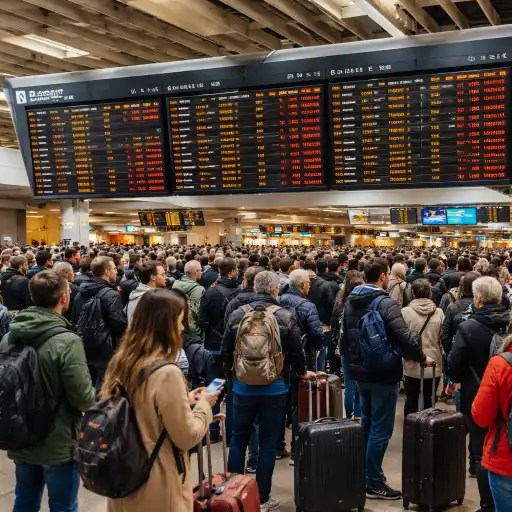
Departure boards across major terminals reflected the strain as flights cycled between delayed and canceled status, while long queues formed at customer service counters where passengers sought clarity, rebooking options, and in some cases overnight accommodation.
For many commuters traveling at the start of the working week, the disruption extended beyond inconvenience, threatening cross border meetings, project deadlines, and commercial engagements that depend on the reliability of Europe’s dense air corridor system.
Families returning from seasonal breaks found themselves navigating crowded waiting areas as children rested against suitcases and parents refreshed airline applications in search of updates, underscoring how swiftly operational strain can spill into personal travel plans.
Industry analysts note that Europe’s aviation network functions as a finely balanced system in which localized setbacks rarely remain isolated, instead spreading outward along shared routes, alliance partnerships, and code share agreements that bind carriers together.
Representatives from SAS, Iberia, and KLM emphasized that safety considerations guide every operational decision and that preemptive cancellations are sometimes necessary to prevent broader systemic breakdowns later in the day, though the immediate passenger impact remains significant.
Air traffic management authorities in parts of northern Europe introduced temporary flow controls to manage congestion in busy airspace corridors, a precaution intended to preserve safety margins but one that inevitably slows departure sequences and arrival patterns.
Ground handling providers, already operating within tight winter staffing parameters, faced the dual challenge of de icing aircraft and coordinating revised gate assignments, stretching turnaround intervals and complicating airline recovery strategies.
The disruptions coincide with a period when several European cities are hosting trade fairs, cultural events, and academic conferences, heightening the economic stakes as organizers and attendees confront travel uncertainty and compressed schedules.
Rail operators on key cross border corridors reported a modest surge in last minute bookings as some travelers opted for high speed alternatives, although capacity limitations and journey duration differences mean rail cannot absorb all displaced air demand.
Airlines have urged affected customers to rely on digital self service platforms for rebooking and real time updates, reflecting the industry’s increasing dependence on automated systems to manage irregular operations at scale.
Consumer rights organizations have reminded passengers of their entitlements under European aviation regulations, which provide for assistance such as meals and accommodation and, under certain circumstances, financial compensation when delays or cancellations meet defined thresholds.
At major hubs including Schiphol and Madrid, airport authorities coordinated with carriers to deploy additional support staff and distribute basic amenities, attempting to ease pressure within departure halls that grew progressively more congested as the day unfolded.
Behind the scenes, airline operations control centers worked continuously to reposition aircraft and reassign crew within duty time limitations, seeking to restore schedule integrity and prevent further knock on effects into subsequent travel waves.
Meteorological forecasts suggest that weather conditions may gradually stabilize, yet aviation planners caution that recovery from widespread disruption often extends beyond the initial disturbance as fleet rotations and staffing rosters must be recalibrated with precision.
For frequent flyers accustomed to seamless short haul connections across the continent, the episode serves as a reminder of the delicate choreography required to coordinate thousands of daily movements across multiple jurisdictions, languages, and regulatory frameworks.
As the situation evolves, carriers will be measured not only by the speed with which they restore normal operations but also by the transparency and consistency of their communication with passengers navigating uncertainty at crowded gates and check in zones.
For now, terminals across Denmark, Spain, Sweden, and the Netherlands stand as visible markers of a network under strain, where Europe’s promise of swift and predictable mobility has been temporarily unsettled by operational pressures that expose the fragility beneath its vast connectivity.