Strategic supply chain pact signals Europe’s pivot toward Asia as global trade tensions reshape economic alliances

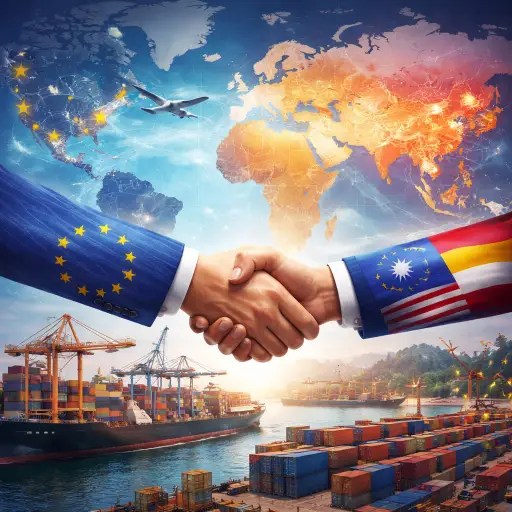
Brussels and several leading Indo-Pacific capitals are quietly advancing exploratory talks that could evolve into one of the most consequential economic realignments of the year, as the European Union and a 12-nation Indo-Pacific trade bloc assess the foundations of a far-reaching alliance designed to strengthen supply chains and reduce exposure to rising tariff pressure from the United States.
The initiative emerges at a sensitive moment in global commerce, with renewed US tariff measures affecting industrial goods, green technologies and selected high-value components, prompting European policymakers to accelerate efforts to diversify trade relationships and reinforce economic resilience beyond traditional transatlantic frameworks.
According to senior officials familiar with the discussions, the proposed alliance would prioritize cooperation in strategically vital sectors including semiconductors, rare earth minerals, advanced batteries, pharmaceuticals and clean energy technologies, all areas where recent disruptions have exposed structural vulnerabilities in concentrated sourcing models.
For the European Union, the talks reflect a broader strategic recalibration that seeks to balance longstanding ties with Washington while building deeper commercial corridors across Asia and the Pacific, regions that have become central to global manufacturing capacity and innovation networks.
The Indo-Pacific bloc, composed largely of export-oriented economies, views closer alignment with Europe as an opportunity to secure stable access to one of the world’s largest consumer markets while strengthening its role in shaping international regulatory standards and investment flows.
Diplomats describe the early exchanges as pragmatic rather than ideological, emphasizing that the objective is not confrontation but diversification, as both sides seek to cushion their industries from volatility generated by tariff escalations and shifting industrial policies in major economies.
Rather than pursuing a single sweeping free trade agreement, negotiators are said to be considering a modular architecture built around sector-specific accords, allowing participating countries to advance cooperation in priority industries without being delayed by politically sensitive areas such as agriculture or public procurement.
Business leaders in key European manufacturing hubs have responded cautiously but positively, noting that stable access to Indo-Pacific suppliers could help offset cost pressures triggered by tariff barriers and provide greater certainty for long-term investment planning in green and digital transitions.
At the same time, Indo-Pacific exporters see potential gains in expanded capital inflows, joint research initiatives and deeper integration into European value chains, particularly as global demand patterns continue to shift amid geopolitical fragmentation.
Trade analysts argue that the geopolitical implications of a structured Europe–Indo-Pacific partnership would be substantial, given the combined economic weight of the two regions and their influence within multilateral institutions that govern trade, finance and development standards.
Still, significant hurdles remain, including regulatory divergence in digital governance, sustainability requirements and labor protections, all of which are likely to feature prominently in formal negotiations should exploratory discussions mature into structured talks.
Despite these challenges, diplomatic engagement has intensified in recent weeks, with working groups mapping areas of rapid convergence and identifying mechanisms to streamline customs procedures, harmonize technical standards and coordinate strategic investment screening.
Investors are closely monitoring the trajectory of the discussions, calculating that deeper integration between Europe and the Indo-Pacific could unlock new cross-border ventures in advanced manufacturing, renewable infrastructure and high-tech production ecosystems.
Whether the initiative ultimately results in a formalized alliance remains uncertain, yet the political signal is unmistakable as Europe demonstrates a willingness to look beyond its traditional partners in order to reinforce economic sovereignty and adapt to a trade environment defined by tariff escalation and strategic competition.
In that context, the exploratory talks represent more than a commercial exercise; they illustrate a broader reconfiguration of global trade patterns, as two economically powerful regions consider weaving new connective frameworks across continents in response to mounting uncertainty in established markets.