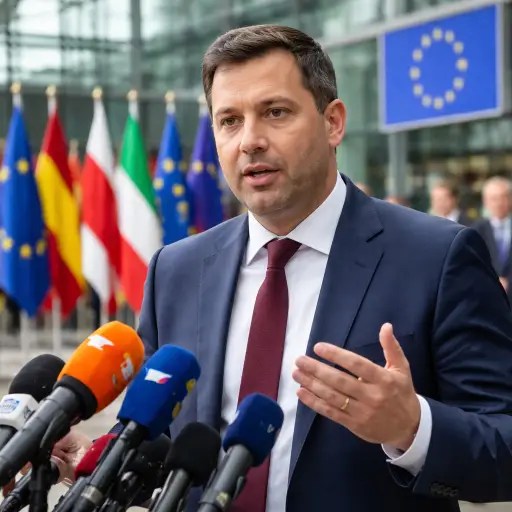
Lars Klingbeil urges EU governments to move beyond narrow national interests and accelerate integration as geopolitical pressures mount across the bloc
German Finance Minister Lars Klingbeil has delivered a stark warning to European Union governments, arguing that the bloc risks weakening itself if member states continue to prioritize short-term national calculations over collective European strategy.
Speaking amid intensifying debates over defense financing, industrial competitiveness and fiscal reform, Klingbeil said Europe is entering a decisive phase in which unity is no longer an abstract ideal but a practical necessity shaped by geopolitical rivalry and economic transformation.
The minister’s remarks come at a moment of heightened global uncertainty, with security tensions lingering on the continent’s eastern borders, trade frictions sharpening among major powers and technological competition accelerating at a pace that challenges Europe’s traditional regulatory approach.
Klingbeil stressed that while national governments remain accountable to their domestic electorates, the instinct to retreat behind national interests during times of strain ultimately undermines the very stability those governments seek to protect.
“If every country only looks inward, Europe as a whole will be weaker,” he said, framing cooperation not as a concession of sovereignty but as its reinforcement in a world increasingly defined by power blocs and strategic competition.
At the center of his appeal is a push for stronger European sovereignty built on common investment, coordinated fiscal policy and a more integrated capital market capable of channeling private savings into strategic industries across borders.
The debate over how to finance defense modernization and the green transition has exposed familiar fault lines within the bloc, with fiscally cautious states wary of shared borrowing and others arguing that fragmented national spending will prove more costly in the long run.
Germany itself has faced scrutiny over its budget priorities and industrial policy, yet Klingbeil signaled that Berlin is prepared to support pragmatic reforms of EU fiscal rules that combine debt sustainability with sufficient flexibility to fund long-term strategic investments.
European officials say the conversation has shifted noticeably in recent months, as policymakers acknowledge that reliance on external suppliers for energy, critical minerals and advanced technologies carries risks that cannot be mitigated through national measures alone.
Klingbeil’s intervention reflects a broader recalibration underway in several capitals, where leaders are reassessing the balance between open markets and strategic autonomy in light of lessons drawn from recent crises.
Rather than advocating protectionism, the German finance minister argued for what he described as an open but resilient Europe, capable of defending its economic interests while remaining committed to global trade and multilateral cooperation.
That approach would require deeper coordination in areas ranging from joint defense procurement and energy infrastructure to research funding and industrial standards, all designed to prevent duplication and strengthen Europe’s bargaining power abroad.
Financial markets have responded cautiously to the renewed discussion of integration, with investors weighing the potential benefits of a more unified European bond market against the political hurdles that have historically slowed collective decision-making.
Diplomats in Brussels note that moments of crisis often generate momentum for reform, yet sustaining that momentum once immediate pressures ease has proven more difficult, raising questions about whether the current push will translate into lasting structural change.
Klingbeil acknowledged the political sensitivities involved, particularly in countries where debates over sovereignty remain charged, but he insisted that genuine sovereignty in the twenty-first century depends on the capacity to act together when strategic interests align.
The minister also linked European cooperation directly to citizens’ everyday concerns, arguing that coordinated policy can help stabilize prices, protect jobs and support innovation in ways that isolated national responses cannot achieve.
Inflationary pressures and uneven growth across the bloc have fueled domestic political tensions, creating fertile ground for nationalist narratives that portray Brussels as distant or intrusive, yet Klingbeil contended that fragmentation would exacerbate rather than solve these challenges.
Supporters of deeper integration point to past episodes in which delayed coordination amplified economic shocks, arguing that swift collective action has repeatedly demonstrated its value during moments of systemic stress.
Critics, however, caution that expanding common financial instruments without clear safeguards could dilute fiscal discipline and generate moral hazard, a concern that continues to shape negotiations over the future architecture of the euro area.
Klingbeil sought to bridge that divide by emphasizing accountability and transparency, suggesting that reforms can be designed to respect national responsibility while still unlocking the scale of investment required to compete globally.
The broader geopolitical backdrop adds urgency to the debate, as shifting alliances and evolving security dynamics compel European governments to reassess their strategic posture in a rapidly changing international order.
Transatlantic relations remain a cornerstone of European security, yet uncertainty about long-term global commitments has prompted renewed reflection on Europe’s own capacity to shoulder greater responsibility.
In that context, calls for enhanced defense coordination and shared procurement have gained traction, with officials arguing that fragmented national systems drive up costs and hinder interoperability among armed forces.
Industrial policy has emerged as another focal point, particularly as major economies deploy large-scale subsidies to support domestic manufacturing in sectors such as clean technology and semiconductors.
European leaders face the delicate task of responding to these external pressures without triggering subsidy races within the single market that could distort competition among member states.
Klingbeil’s warning against hiding behind national interests was widely interpreted in Brussels as a signal that Germany is prepared to engage constructively in negotiations over new common tools, provided they are anchored in clear strategic objectives.
Analysts say the coming months will test the political will of EU governments as they navigate budget discussions, defense planning and industrial strategy debates that will shape the bloc’s trajectory for years to come.
For many observers, the central question is whether Europe can transform rhetorical commitments to unity into concrete policy measures that enhance resilience without eroding democratic legitimacy at the national level.
Klingbeil’s message was ultimately framed as a call to responsibility rather than a rebuke, urging partners to recognize that the European project’s promise of peace, prosperity and global influence depends on sustained cooperation.
As geopolitical competition intensifies and economic transitions accelerate, the German finance minister argued, Europe’s strength will be measured not by the assertiveness of individual capitals but by the coherence of their collective action.
Whether that appeal resonates beyond conference halls and ministerial meetings will determine how effectively the European Union navigates the challenges ahead, at a moment when hesitation carries costs that few governments can afford to ignore.

 The Tower Post