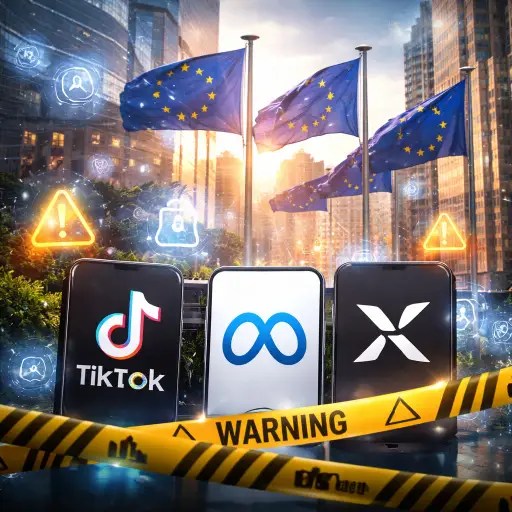
As Brussels and national regulators intensify scrutiny of AI-driven harms on major social platforms, transatlantic tensions simmer beneath the surface.
European policymakers are entering a decisive phase in their long-running effort to rein in the power of global technology platforms, as regulators across the continent sharpen their focus on how social-media giants deploy artificial intelligence and whether automated systems are amplifying harmful or misleading content.
From Brussels to national capitals, officials argue that the rapid integration of generative AI into social platforms has outpaced existing safeguards, allowing synthetic images, cloned voices and AI-written posts to circulate at a velocity that challenges traditional moderation systems and tests the resilience of democratic debate.
The concern is no longer confined to online civility, regulators say, but extends to electoral integrity, public health messaging and national security, particularly as AI-generated material becomes increasingly difficult for ordinary users to distinguish from authentic content.
Under the European Union’s sweeping digital rulebook, authorities are demanding more granular disclosures from companies about how their recommendation engines and AI tools function, pressing firms to demonstrate that they have conducted meaningful risk assessments and installed safeguards against coordinated manipulation.
Several member states are moving beyond Brussels’ baseline requirements, with media watchdogs in Western Europe launching inquiries into the use of generative AI in political advertising while consumer-protection agencies elsewhere examine whether minors are sufficiently shielded from algorithmically curated streams that can spiral into extremism or self-harm themes.
Executives at major platforms including Meta, X and TikTok insist that they have invested heavily in AI safety teams and content moderation infrastructure, pointing to transparency reports, partnerships with fact-checkers and new watermarking tools designed to label synthetic material before it spreads widely.
Industry representatives warn that overly rigid European rules could stifle innovation at a time when global competition in artificial intelligence is intensifying, arguing that compliance costs and legal uncertainty may divert resources away from research and product development.
European lawmakers remain unconvinced, describing what they see as an accountability gap between corporate assurances and the lived experience of users, as civil-society groups document cases in which AI-generated disinformation has spread rapidly before being detected or removed.
In several high-profile incidents, fabricated videos and convincingly altered images ricocheted across platforms and benefited from algorithmic boosts before fact-checkers could respond, reinforcing the perception among policymakers that voluntary commitments are no longer sufficient.
The regulatory clampdown comes at a delicate geopolitical moment, as transatlantic cooperation deepens in areas such as defense and energy while digital governance remains a persistent fault line between Europe and the United States.
American policymakers have historically viewed Europe’s assertive tech regulation with a mix of admiration and irritation, sharing concerns about online harms yet bristling at measures that disproportionately affect companies headquartered in the United States.
Trade lawyers caution that disputes over digital services can quickly spill into broader economic tensions, especially if European authorities impose substantial fines or operational restrictions tied to AI-generated content and affected firms press Washington for a more forceful response.
Diplomats on both sides emphasize ongoing dialogues on artificial intelligence governance and highlight shared democratic values, but the optics of Europe taking on American tech champions resonate strongly in domestic political debates in the United States.
For European leaders, the political calculus is equally complex, as public trust in digital platforms has eroded after years of scandals involving privacy breaches, misinformation and opaque algorithms, creating pressure to demonstrate that governments can protect citizens from unaccountable tech power.
At the same time, policymakers must ensure that compliance burdens do not deter investment or hamper Europe’s own ambitions to cultivate competitive homegrown technology firms capable of thriving in the global AI race.
The rise of generative AI has injected new urgency into these debates because the systems now embedded in social platforms can produce convincing text, images and audio at scale, raising fears that deepfakes and automated propaganda campaigns could become indistinguishable from authentic civic discourse.
Policy experts argue that Europe’s approach may set de facto global standards, as companies adapt their AI moderation systems to satisfy European requirements and potentially extend those changes to other markets to avoid maintaining fragmented compliance regimes.
That prospect is one reason Washington is watching closely, wary of a regulatory landscape that could compel American firms to navigate divergent rules across jurisdictions and complicate negotiations over technology standards and cross-border data flows.
Business groups on both sides of the Atlantic are urging a cooperative path forward, advocating joint frameworks on AI transparency, shared research on content authentication technologies and interoperable reporting standards that preserve a high level of user protection without triggering trade retaliation.
For now, however, European regulators appear determined to test the limits of their authority, signaling that the era of light-touch oversight is over and that platforms must prove their AI systems do not undermine the democratic and social fabric of the societies in which they operate.
As scrutiny intensifies and compliance deadlines loom, the confrontation over AI-generated harm is shaping up as more than a regulatory dispute, evolving instead into a defining chapter in the transatlantic relationship and a test of how democracies govern the technologies that increasingly shape public life.



 The Tower Post