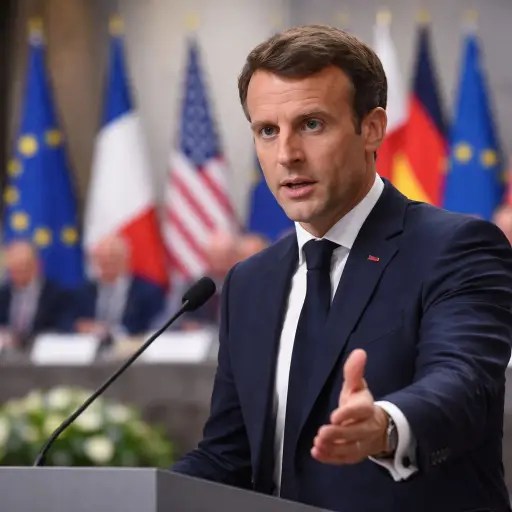
French President calls for European economic and defense sovereignty amid trade tensions with China and uncertainty from the United States
French President Emmanuel Macron delivered a stark warning about what he called a “world in disarray,” arguing that Europe faces mounting pressure from both China’s trade posture and a volatile United States and must now assert itself as a global power capable of defending its own economic and security interests.
Speaking before an audience of diplomats, lawmakers and defense officials, Macron described an international order increasingly shaped by rivalry, economic coercion and fragile alliances, warning that Europe can no longer rely on assumptions that once underpinned global stability.
He pointed directly to China’s expanding industrial output and aggressive export strategy, which European officials say are distorting competition in key sectors such as electric vehicles, renewable technologies and advanced manufacturing, placing heavy strain on European producers already navigating a fragile recovery.
Brussels has opened trade investigations and debated countermeasures, yet divisions persist among member states over how firmly to respond, reflecting the broader tension between defending strategic industries and preserving open-market principles that form the backbone of the European Union.
At the same time, Macron underscored uncertainty surrounding the United States, Europe’s historic ally, noting that shifts in American domestic politics and recurring debates over NATO burden-sharing have forced European leaders to confront the possibility of a less predictable transatlantic partnership.
Without questioning the value of the alliance, Macron argued that Europe must strengthen its own defense capabilities to ensure that cooperation with Washington remains balanced rather than dependent, insisting that sovereignty enhances alliances rather than weakens them.
The president framed sovereignty not only in military terms but also in economic resilience, calling for greater investment in strategic industries including semiconductors, battery production and critical raw materials essential to the green transition and digital economy.
He stressed that supply chain vulnerabilities exposed in recent years demonstrate the cost of overdependence, particularly in areas where geopolitical tensions can rapidly translate into economic disruption.
Macron also renewed calls for a stronger European defense industrial base capable of sustaining long-term commitments and supporting partners such as Ukraine, whose ongoing war has reshaped Europe’s security calculations and revived hard-power considerations across the continent.
The war has served as a stark reminder, he said, that peace cannot be taken for granted and that Europe must be prepared to defend its territory, values and interests in an increasingly contested geopolitical landscape.
Financial markets reacted cautiously to the speech, with defense-related shares showing modest gains amid expectations of increased spending while trade-sensitive sectors weighed the implications of potential new tariffs or regulatory barriers.
Within France, Macron’s vision has sparked familiar political debate, as supporters argue that his push for European autonomy reflects strategic foresight while critics question the fiscal burden and domestic trade-offs associated with deeper integration and higher defense outlays.
Across the European Union, however, the concept of strategic autonomy has moved from the margins to the mainstream, with recent initiatives on energy diversification, digital regulation and industrial policy suggesting that consensus, though incomplete, is steadily forming.
Macron concluded by urging European leaders to move beyond incremental reforms and act with urgency, warning that hesitation risks leaving Europe reactive in a world increasingly shaped by larger powers pursuing their own interests.
As global dynamics continue to shift, his message resonates as both caution and challenge, placing the responsibility squarely on Europe to determine whether it will remain a secondary actor or emerge as a central force in shaping the next chapter of international order.
 The Tower Post