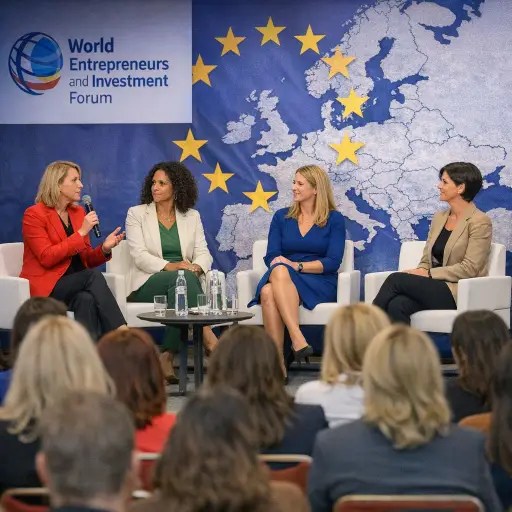
At the World Entrepreneurs and Investment Forum, leaders argue that gender equity is not only a social imperative but a strategic engine for growth and innovation

Europe’s economic future is being reshaped with women at its center, as policymakers, investors and founders convened at the World Entrepreneurs and Investment Forum to make the case that empowering female entrepreneurs is no longer simply a matter of equality but a strategic necessity for sustainable growth.
Amid mounting geopolitical uncertainty, supply chain recalibrations and the accelerating green and digital transitions, speakers stressed that Europe cannot afford to sideline the innovative capacity of half its population if it intends to remain globally competitive.
Throughout the forum, panelists returned to a persistent imbalance: women-led enterprises continue to receive a disproportionately small share of venture capital and private equity, despite data showing that diverse leadership teams often deliver stronger long-term performance and higher levels of innovation.
Investors acknowledged that structural biases still shape funding decisions, with established networks and pattern recognition models frequently favoring founders who fit traditional profiles, thereby limiting the flow of capital to women operating in high-growth sectors such as clean technology, artificial intelligence and advanced manufacturing.
Entrepreneurs shared firsthand accounts of navigating closed networks and informal gatekeeping mechanisms that can determine access to investors, strategic partnerships and cross-border expansion opportunities, reinforcing the need for more transparent and inclusive ecosystems.
Beyond financing, the forum highlighted leadership representation as a decisive factor in economic transformation, noting that women remain underrepresented on corporate boards, in innovation clusters and within major financial institutions where capital allocation strategies are defined.
European policymakers participating in the discussions pointed to recent initiatives designed to expand access to public procurement, innovation grants and blended finance mechanisms for women-led small and medium-sized enterprises, while conceding that implementation gaps persist across member states.
Corporate executives described mentorship schemes, accelerator platforms and targeted investment funds as practical tools to narrow opportunity gaps, arguing that structured support systems can accelerate scaling and strengthen investor confidence in emerging female founders.
The prevailing tone of the gathering was forward-looking rather than corrective, with speakers framing gender equity as a catalyst for unlocking untapped markets, stimulating job creation and strengthening Europe’s resilience in an era of rapid technological change.
Workshops dedicated to sustainable innovation showcased women-led ventures advancing climate adaptation technologies, circular economy solutions and digital health services, underscoring the argument that inclusion is directly linked to the continent’s strategic priorities.
Economists at the event warned that demographic pressures and labor shortages demand a more comprehensive mobilization of entrepreneurial talent, positioning women’s economic participation as essential to productivity gains and fiscal stability.
Calls for harmonized regulatory frameworks across the European single market reflected concerns that fragmented rules can disproportionately burden smaller firms, including those led by women seeking to expand beyond national borders.
Financial institutions were urged to publish transparent data on lending and investment patterns, a move advocates believe would expose persistent disparities and create accountability mechanisms capable of reshaping capital flows.
Education and early-stage support also featured prominently, with participants emphasizing the importance of fostering entrepreneurial ambition among young women through digital skills training, access to STEM pathways and visible role models in leadership positions.
Several speakers noted that impact investing criteria increasingly incorporate gender diversity metrics, signaling a shift in how value creation and risk assessment are measured within European capital markets.
Despite signs of progress, the consensus was that incremental change will not be sufficient to close structural gaps, and that coordinated action between governments, private investors, universities and civil society will be required to deliver measurable results.
As debates unfolded, a clear narrative emerged: gender equity is not an auxiliary social objective but a core economic strategy capable of accelerating innovation, broadening the tax base and reinforcing Europe’s position in global value chains.
The forum concluded with a collective call for tangible commitments, urging institutions and corporations to align funding pipelines, procurement strategies and leadership development programs with the objective of embedding women at the center of economic decision-making.
In conversations that continued well beyond the formal sessions, participants expressed cautious optimism that Europe stands at a pivotal moment, where translating rhetoric into investment and structural reform could define the next chapter of its economic transformation.
As the dialogue closed on this symbolic mid-February gathering, the message resonated clearly across the auditorium: Europe’s capacity to renew itself will depend not only on technological breakthroughs or fiscal reforms, but on whether it fully embraces the entrepreneurial power and leadership of its women.