Swedish researchers uncover unexpected kinship patterns in Stone Age graves, reshaping our understanding of prehistoric family life in northern Europe

In a discovery reshaping Europe’s deep past, scientists in Sweden have used ancient DNA to unlock the secrets of Stone Age graves that have puzzled archaeologists for generations, revealing that burial sites dating back more than five millennia did not always hold simple nuclear families as once assumed but instead preserved far more intricate stories of extended kinship, social bonds and community structures that challenge modern assumptions about prehistoric life.
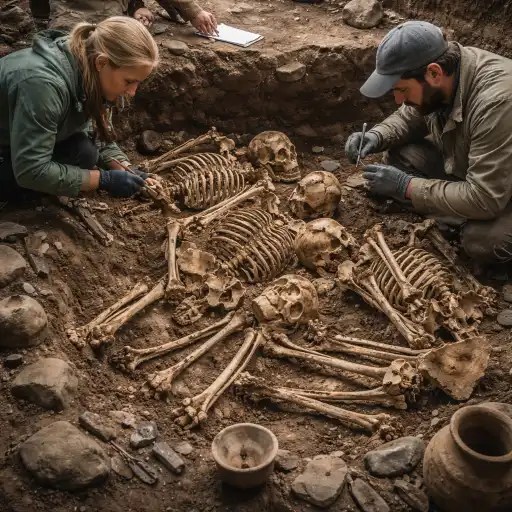
The interdisciplinary team of geneticists and archaeologists focused on a series of collective graves in northern Europe, burial chambers long interpreted as straightforward family tombs where parents were laid beside children and siblings beside siblings, yet new genetic evidence has revealed a more complex social landscape embedded within those ancient resting places.
By extracting and sequencing DNA from skeletal remains preserved in Stone Age burial sites across Sweden, researchers reconstructed biological relationships among individuals interred together, drawing on technological advances that now allow scientists to recover detailed genetic information from bones and teeth even after thousands of years.
The results were striking, showing that while many individuals sharing a grave were related, they were not always immediate family members, and instead of clear parent-child clusters the graves frequently contained extended relatives such as cousins, uncles, aunts and more distant kin whose presence together signals broader family networks at work.
In several cases individuals with no close genetic ties were buried alongside relatives, suggesting that social bonds, shared identity or communal affiliation may have been as significant as blood relationships in determining who was laid to rest together.
Researchers say the burial sites reflect communities rather than isolated households, and the emerging genetic patterns point to a prehistoric social organization more layered and dynamic than the compact nuclear family model once projected onto early European farming societies.
For decades archaeologists debated whether early agrarian communities in northern Europe were structured around tightly bound family units or larger kin groups, relying on artifacts, burial layouts and settlement patterns to infer social systems in the absence of written records.
Ancient DNA analysis is now offering a direct biological window into those relationships, enabling scholars to test long-held theories against measurable genetic evidence and to reassess assumptions that have shaped interpretations of European prehistory.
The graves belong to communities living during a transformative era when populations were shifting from foraging to farming lifestyles, settling more permanently, cultivating crops and domesticating animals in ways that likely reshaped inheritance rules, residence patterns and social cohesion.
The genetic data indicates that extended kin networks played a central role in these societies, with burial groupings reflecting broader lineage connections that may have reinforced cooperation, resource sharing and collective resilience during times of change.
One grave that archaeologists had previously believed to contain a mother, father and child instead revealed two distant relatives and a third individual with no immediate genetic link, underscoring how assumptions based on spatial arrangement alone can obscure the true nature of ancient relationships.
Across multiple sites researchers identified clusters of related males that may point to patrilineal traditions in which descent and inheritance were traced through the male line, while the greater genetic diversity observed among women suggests patterns of mobility consistent with marriage alliances between communities.
These findings provide rare and tangible insight into family life more than five thousand years ago, offering a detailed glimpse of how prehistoric people organized their social worlds and navigated belonging, identity and obligation.
Beyond archaeology the implications extend to understanding how complex social structures evolved over time, shaping later systems of property ownership, leadership and political organization rooted in kinship and collective identity.
The study also highlights the rapid progress of ancient DNA research, a field that has transformed from speculative possibility into a central pillar of historical inquiry as laboratories across Scandinavia and Europe revisit long-excavated burial sites with new analytical tools.
As late winter turns toward the promise of spring, the findings serve as a reminder that the distant past continues to speak through scientific innovation, revealing that communities who lived and died more than five millennia ago built social networks that were resilient, interconnected and far more complex than once imagined.