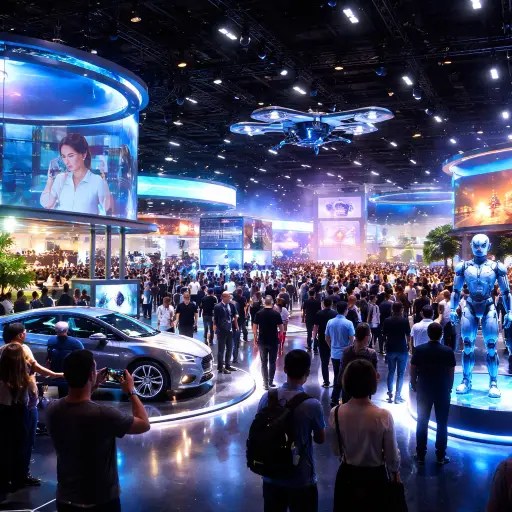
From FDA-ready wearables to hands-free AR payments and next-generation energy breakthroughs, Las Vegas becomes a living laboratory of tomorrow’s world.
Las Vegas has once again transformed into a cathedral of circuitry and code as CES 2026 closes with a clear message echoing across exhibition halls and executive forums: the future is no longer approaching, it is operational.
The massive technology showcase drew approximately 148,000 attendees and more than 4,100 exhibitors, turning what was once primarily a gadget expo into a living, breathing prototype of tomorrow’s economy.
This year’s event felt less like a preview of distant possibilities and more like a deployment summit, where companies emphasized regulatory milestones, shipping timelines, and industrial partnerships rather than speculative concepts.
In the health technology sector, wearable devices demonstrated how far the industry has advanced beyond step counting and sleep tracking into clinically significant territory.
Several companies unveiled FDA-ready wearables capable of continuously monitoring cardiac rhythms, metabolic markers, stress indicators, and early warning signs of chronic conditions, signaling a decisive shift from consumer wellness accessories to medical-grade tools.
Executives described a healthcare system increasingly built around predictive insight rather than reactive treatment, with continuous monitoring designed to reduce hospital visits and empower patients with real-time data.
Augmented reality glasses emerged as one of the most talked-about categories on the show floor, drawing crowds eager to test hands-free translation, contextual navigation overlays, and gesture-based digital payments.
In live demonstrations, users ordered coffee in unfamiliar languages, collaborated on shared holographic schematics, and completed transactions without touching a phone, underscoring how computing is dissolving into the environment itself.
Artificial intelligence was not showcased as a novelty feature but as foundational infrastructure embedded in nearly every product category on display.
Home appliances adjusted recipes to dietary data, enterprise platforms drafted analytical reports and simulated market scenarios, and vehicles learned driver behavior while anticipating hazards in real time.
Industry leaders repeatedly stressed that the conversation has shifted from what artificial intelligence can do to how responsibly and efficiently it can be deployed at scale across industries.
Mobility technology reflected a similar transition from promise to practicality, with electric vehicles offering improved range, faster charging cycles, and increasingly sophisticated driver assistance systems.
Autonomous platforms demonstrated smoother urban navigation through enhanced sensor fusion and advanced decision-making software, while modular battery systems hinted at more flexible fleet conversions.
Transportation, long dominated by mechanical engineering, now appears equally defined by software architecture and data ecosystems.
Energy innovation formed a strategic undercurrent throughout the exhibition, where solid-state battery prototypes, high-efficiency solar materials, and exploratory nuclear fusion research pointed toward an accelerating clean energy transition.
Companies spoke less about distant breakthroughs and more about pilot programs, grid integration strategies, and commercial partnerships aimed at scaling sustainable power solutions.
Enterprise technologies reinforced the broader narrative of applied innovation, with adaptive cybersecurity systems, collaborative industrial robotics, and digital twins demonstrating how simulation and automation can build resilience in uncertain markets.
Speakers emphasized that competitive advantage increasingly depends on agility and durability rather than speed alone, particularly in a global economy defined by volatility.
Beyond individual product launches, CES 2026 revealed a deeper convergence between consumer and enterprise ecosystems, as devices designed for personal use feed analytics platforms that influence industrial operations and urban infrastructure.
The mood across Las Vegas was notably pragmatic, with venture capital conversations centered on scalability and profitability rather than conceptual disruption.
Privacy advocates and policy experts, however, reminded attendees that governance must evolve alongside deployment, particularly as data-rich systems become embedded in daily life.
Supply chain specialists cautioned about material constraints tied to rare earth elements and advanced semiconductors, underscoring that innovation is inseparable from logistics.
Yet even these cautions reinforced a central theme of the week: the technologies under debate are real enough to demand oversight because they are already in motion.
As the exhibition halls emptied and screens dimmed, the overarching impression was not one of spectacle but of integration.
CES 2026 did not showcase science fiction; it showcased iteration, refinement, and convergence across sectors that once operated independently.
In an era where innovation cycles compress rapidly, prototypes become platforms and platforms quickly become policy considerations, the distance between demonstration and daily use continues to narrow.
The takeaway from Las Vegas is not merely that technology is advancing quickly, but that it is embedding itself quietly and pervasively into the fabric of contemporary life.
Tomorrow, as CES 2026 makes clear, is not waiting on the horizon; it is already being installed, integrated, and improved in real time.




 The Tower Post