Bloc Signals Strategic Turn Toward Industrial Sovereignty in Defence, Clean Tech, AI and Space Amid Global Economic Turbulence
European Union leaders have agreed to press forward with a controversial “Buy European” policy, endorsing plans to prioritise European-made products in public procurement and strategic sectors in what many see as a decisive shift in the bloc’s economic doctrine.
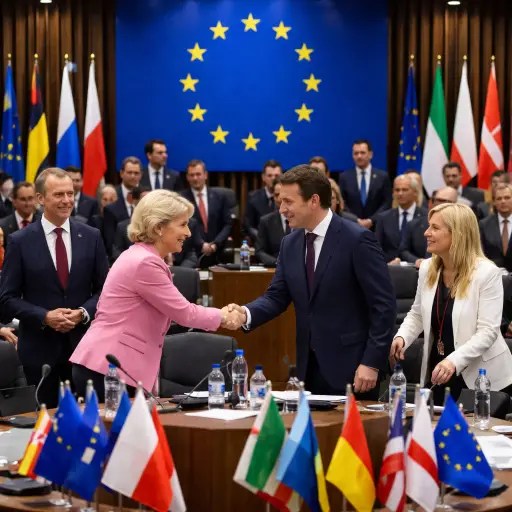
The agreement emerged from a high-level summit in Brussels where heads of state and government signalled broad political backing for a strategy designed to reinforce Europe’s industrial base at a time of heightened geopolitical tension and economic volatility.
The initiative targets defence, clean technologies, artificial intelligence and space, sectors viewed as critical to the continent’s security, technological edge and long-term competitiveness in an increasingly fragmented global economy.
Under the proposed framework, public projects financed at national or EU level would give preference to companies manufacturing within the Union or meeting defined European content thresholds, although officials insist the approach will be calibrated rather than absolute.
The move reflects mounting concern in Brussels that Europe risks strategic dependence in areas central to its prosperity, particularly as global supply chains remain vulnerable and major powers channel vast public funds into their own industrial champions.
In defence, leaders are expected to promote joint procurement schemes and channel greater investment toward European manufacturers, seeking to reduce reliance on external suppliers while fostering cross-border industrial cooperation within the single market.
Clean technology is another pillar of the strategy, with policymakers eager to anchor the production of batteries, renewable energy components and advanced semiconductors inside Europe as the green transition accelerates.
Artificial intelligence and space capabilities have also been singled out as domains where European firms must scale rapidly to compete with global rivals, and officials argue that procurement policy can serve as a powerful lever to nurture domestic innovation ecosystems.
Yet beneath the outward unity, the debate has exposed fault lines between member states advocating a more protective industrial stance and those determined to preserve the Union’s long-standing commitment to open markets and multilateral trade rules.
Export-oriented economies have warned that overt protectionism could invite retaliation from trading partners and undermine Europe’s credibility as a champion of free trade, cautioning that competitiveness cannot be built through isolation.
Several smaller and northern member states have pressed for safeguards to ensure compatibility with international trade obligations, arguing that Europe’s prosperity has historically depended on openness and integration into global value chains.
Conversely, larger industrial powers have argued that the global landscape has shifted fundamentally, pointing to expansive subsidy programmes in other major economies as justification for a more assertive European response.
Supporters of the initiative contend that the policy is less about closing borders and more about strengthening resilience, insisting that strategic autonomy is compatible with international engagement if designed with precision.
European Commission officials are now preparing a broader action plan expected to outline funding instruments, revised procurement guidelines and potential adjustments to state aid rules aimed at supporting industrial expansion across the bloc.
One central challenge will be preventing fragmentation within the single market, as wealthier member states possess greater fiscal capacity to subsidise domestic industries, raising concerns about uneven competition inside the Union.
To address this imbalance, discussions are under way about expanding EU-level financing tools to ensure that all member states can participate in the industrial push without distorting internal competition.
International observers are watching closely, aware that a stronger European industrial policy could reshape trade relationships and influence the broader trajectory of global economic governance.
The policy also mirrors a wider global trend in which governments increasingly intervene in strategic sectors to shield domestic capabilities amid rising geopolitical rivalry and economic uncertainty.
As negotiations continue, technical questions remain over how strictly European content requirements will be defined, how compliance will be monitored and how smaller economies will be protected from unintended consequences.
For now, however, the political message is clear: confronted with global turbulence and intensifying competition, EU leaders have chosen to assert a more proactive role in shaping Europe’s economic destiny.
Whether the “Buy European” drive ultimately enhances competitiveness or strains the bloc’s commitment to open trade will depend on the fine print of the forthcoming measures, but the direction of travel signals a profound evolution in Europe’s industrial strategy.



 The Tower Post