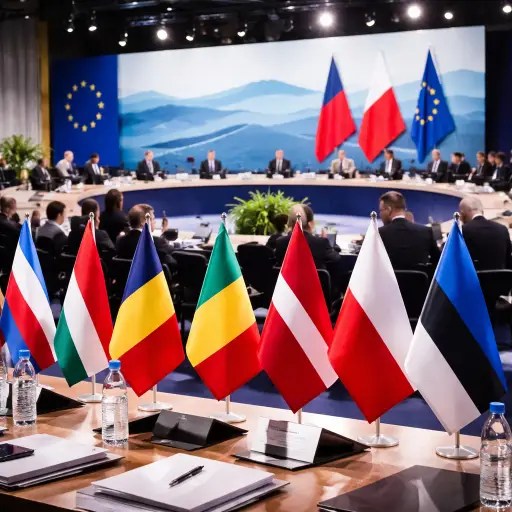
Regional analysts say Warsaw must deepen cooperation across the Baltic, Adriatic and Black Sea corridor to secure infrastructure, energy and political cohesion.
With geopolitical tensions reshaping Europe’s strategic environment, a prominent policy commentary circulating in diplomatic circles this week argues that Poland should decisively strengthen its engagement in the Three Seas Initiative, positioning itself as the driving force behind a regional bloc that links countries from the Baltic to the Adriatic and Black Seas.
The analysis, released ahead of key European consultations later this winter, contends that the Initiative has reached a pivotal stage in its evolution, moving beyond its original focus on infrastructure coordination toward a broader platform for economic resilience and political alignment in Central and Eastern Europe.
At its core, the Three Seas Initiative was designed to correct long-standing infrastructure imbalances across the region, where transport and energy networks historically ran east to west while north-south links remained underdeveloped, limiting trade efficiency and cross-border integration.
The commentary stresses that Poland, as the largest economy within the Initiative and one of its founding advocates, carries both the responsibility and the strategic opportunity to accelerate flagship projects that connect ports, highways, rail corridors and digital networks along the north-south axis.
Supporters argue that enhancing these connections is no longer merely a matter of economic modernization but a question of strategic resilience, especially at a time when supply chain vulnerabilities and security concerns along NATO’s eastern flank have heightened awareness of regional interdependence.
Energy cooperation occupies a central place in the call for renewed Polish leadership, with analysts urging Warsaw to expand coordination on gas interconnectors, electricity grids and renewable integration in order to reduce fragmentation and reinforce collective bargaining power within the European market.
Poland’s investments in liquefied natural gas terminals and cross-border pipelines are cited as tangible examples of how infrastructure can translate into geopolitical leverage, providing diversification options for neighboring states and strengthening the region’s negotiating position.
Beyond physical infrastructure, the commentary highlights the political dimension of the Initiative, noting that regular consultation among participating states has created an informal but influential forum for articulating shared priorities on competitiveness, defense and EU policy debates.
Critics have occasionally portrayed the Three Seas framework as a potential rival center of gravity within the European Union, yet the latest analysis counters that stronger regional cohesion can complement rather than challenge Brussels by ensuring that eastern member states speak with greater coherence.
Financing remains a critical constraint, however, and the report calls on Poland to champion innovative funding mechanisms that combine EU structural resources, development bank instruments and private capital, thereby transforming ambitious project lists into bankable ventures.
Diplomatically, Warsaw is urged to balance assertiveness with inclusivity, ensuring that leadership does not translate into dominance and that smaller member states perceive the Initiative as a genuinely shared enterprise rather than a vehicle for national ambition.
As policymakers prepare for the next round of regional discussions, the underlying message of the commentary is clear: the Three Seas Initiative has matured into a strategic tool whose effectiveness will depend largely on Poland’s willingness to translate rhetoric into sustained investment, coordinated policymaking and visible results.
In an era marked by uncertainty and shifting alliances, the report concludes, geography can be leveraged as an asset rather than a limitation, and Poland’s decision to double down on regional cooperation may prove decisive in shaping the future cohesion and resilience of Central and Eastern Europe.


 The Tower Post