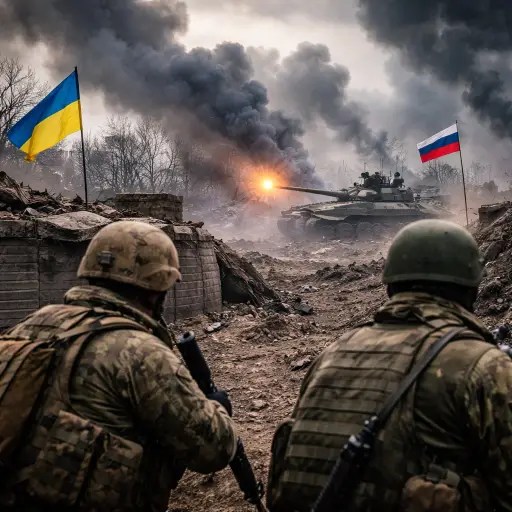
European officials warn Moscow shows no serious signs of ending the war in Ukraine as diplomacy stalls and frontline assaults persist
European Union foreign affairs officials say Russia is “not ready for peace,” arguing that Moscow has shown no tangible engagement toward ending the war in Ukraine despite renewed diplomatic contacts and indirect exchanges involving President Volodymyr Zelenskyy and President Vladimir Putin.
Following consultations among EU member states this week, senior diplomats described the current climate as one of continued military pressure paired with what they called strategic ambiguity from the Kremlin, warning that statements about dialogue have not been matched by concrete steps on the ground.
According to officials briefed on the discussions, exploratory contacts through intermediaries had briefly raised cautious expectations that a pathway to de-escalation might emerge during the late winter period, but those hopes have faded as fighting continues across multiple sectors of the frontline.
“Peace requires more than words,” one EU foreign affairs official said during a background briefing. “At this stage we see no serious signs that Moscow is prepared to engage in a credible process that respects Ukraine’s sovereignty and territorial integrity.”
Ukrainian authorities report persistent shelling in eastern and southern regions, alongside localized ground assaults aimed at consolidating existing positions, developments that European defense analysts interpret as an effort by Russia to strengthen leverage ahead of any future negotiations rather than prepare the conditions for compromise.
President Zelenskyy has maintained that meaningful talks cannot proceed under sustained bombardment, insisting that any ceasefire lacking monitoring mechanisms and security guarantees would risk freezing the conflict without resolving it and allow Russian forces time to regroup.
Moscow has repeatedly signaled that it remains open to negotiations, but Russian officials have framed potential talks around what they describe as new territorial realities and broader security guarantees, positions that Kyiv and its European backers reject as incompatible with international law.
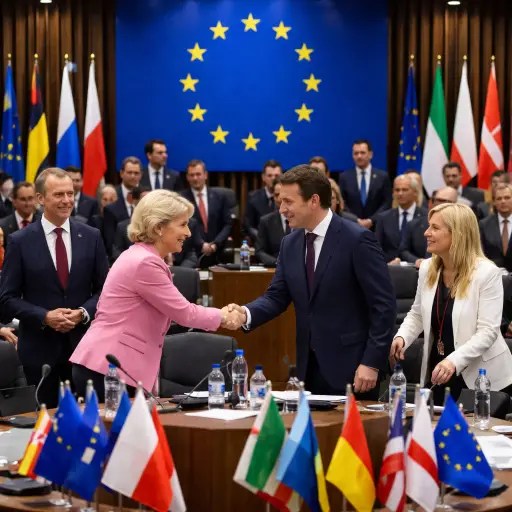
The European Union has reiterated that any durable settlement must be anchored in the principles of the United Nations Charter and internationally recognized borders, with diplomats stressing that while Brussels does not oppose dialogue in principle, engagement must be accompanied by verifiable steps toward de-escalation.
Behind closed doors, EU officials acknowledge that political pressures are mounting across the bloc as governments balance military support for Ukraine with domestic concerns over defense spending, energy resilience and economic competitiveness, even though markets have largely stabilized compared to the early stages of the conflict.
EU High Representative Josep Borrell has urged member states to maintain unity and coordination with transatlantic partners, arguing that the credibility of Europe’s security architecture depends on demonstrating that territorial aggression cannot yield strategic rewards.
Security experts note that the coming weeks could prove decisive as shifting seasonal conditions alter battlefield dynamics, raising the possibility of renewed offensives that would further complicate diplomatic efforts and entrench positions on both sides.
Some European diplomats caution that signaling impatience for talks without substantive Russian concessions could weaken Ukraine’s negotiating position, while others emphasize the need to keep communication channels open to prevent miscalculation and unintended escalation.
For Kyiv, continued Western military assistance remains central to its strategy, with officials calling for expanded air defense capabilities and sustained logistical support to counter ongoing strikes and maintain defensive lines under heavy pressure.
Analysts say Russia’s current posture reflects a calculation that time may work in its favor if Western political consensus fragments, a scenario EU leaders are keen to avoid by projecting solidarity and reinforcing sanctions already in place.
At the same time, European policymakers face the challenge of articulating a long-term vision for regional stability that extends beyond the immediate battlefield, including reconstruction planning, security guarantees and integration pathways for Ukraine.
Diplomats familiar with the recent exchanges say that while neither side has fully closed the door to talks, the absence of confidence-building measures and the continuation of active combat operations leave little room for optimism in the near term.
As discussions continue in European capitals, officials emphasize that peace must be substantive rather than symbolic, warning that premature agreements lacking enforceable commitments could merely postpone renewed violence.
“The door to peace is not locked,” another EU official said, “but it will not open unless Russia demonstrates through actions, not rhetoric, that it is prepared to end the aggression.”
With winter gradually giving way to a new operational phase on the battlefield, European leaders appear determined to pursue a dual-track approach that combines sustained support for Ukraine with readiness for credible negotiations should conditions materially change.
For now, however, the consensus among EU foreign affairs officials is stark: without measurable shifts in Moscow’s conduct and a clear reduction in frontline attacks, the prospect of genuine peace remains distant, and the responsibility for altering that trajectory rests squarely with the Kremlin.


 The Tower Post