A new television series rekindles fascination with her minimalist wardrobe as fashion turns toward restraint and enduring elegance

In an era saturated with spectacle and digital excess, fashion’s latest fixation is strikingly subdued. Nearly three decades after her death, Carolyn Bessette Kennedy’s minimalist wardrobe has returned to cultural prominence, fueled in large part by the success of the television series Love Story. The dramatization has reintroduced her image to a generation too young to remember the original paparazzi photographs, and in doing so has reignited fascination with a style vocabulary built on discipline, precision, and restraint.
Long before the phrase quiet luxury became shorthand for understated affluence, Bessette Kennedy embodied its principles instinctively. Her uniform was composed of bias-cut slip dresses in silk and satin, sharply tailored wool coats, fine-gauge knitwear, straight-leg trousers, and barely-there sandals. The palette rarely deviated from ivory, black, navy, or camel. Logos were absent. Ornamentation was unnecessary. The power of the look resided in proportion, fabric, and an unwavering commitment to simplicity.
The renewed attention arrives at a moment when consumers appear fatigued by maximalism. For years, fashion has cycled through oversized branding, neon color stories, exaggerated silhouettes, and algorithm-driven microtrends designed to dominate social feeds for weeks at a time. Stylists now report a palpable shift in client requests toward clothing that signals polish without ostentation. In that recalibration, Bessette Kennedy’s wardrobe feels not nostalgic but newly relevant.
Retail data reflects the change in mood. Online searches for silk slip dresses, structured overcoats, minimalist eveningwear, and slim black sunglasses have climbed steadily since the series began streaming. Vintage pieces reminiscent of 1990s Calvin Klein tailoring are commanding premium resale prices, while contemporary labels are releasing capsule collections centered on monochrome dressing and fluid silhouettes. The aesthetic language is familiar, yet its reception feels contemporary rather than archival.
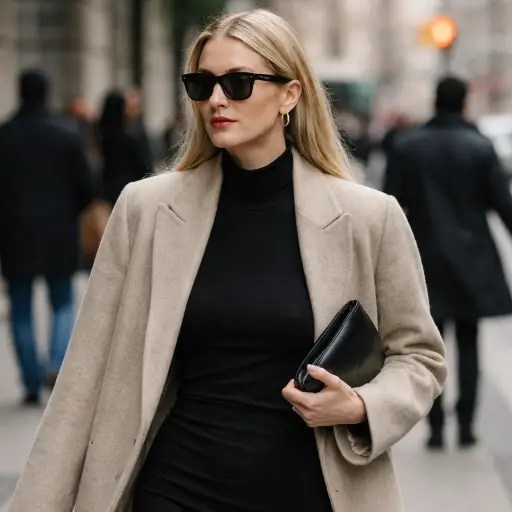
What distinguished Bessette Kennedy was not merely what she wore but how she wore it. Photographs captured her moving through Manhattan in ensembles that appeared effortless yet meticulously edited. A long black coat over a fine turtleneck. A cream slip dress paired with simple sandals. Hair worn loose and unstyled. Accessories reduced to the bare minimum. The absence of visible effort became, paradoxically, a form of authority.
Fashion historians note that the 1990s have long been a wellspring for revival, yet this moment differs from previous waves of nostalgia. Earlier returns emphasized grunge or overt minimalism as aesthetic categories. The current revival is more psychological than stylistic, reflecting a desire for clarity in a visually cluttered era. Bessette Kennedy’s wardrobe functions as a template for coherence, suggesting that elegance can be constructed through subtraction rather than addition.
The series Love Story has played a central role in reframing her image for contemporary audiences. Younger viewers encounter her not as a tabloid figure but as a study in composure. Costume designers involved in the production have emphasized accuracy in fabric and cut, recreating the fluid drape of her slip dresses and the architectural lines of her coats. Social media, ironically, has amplified the very discretion her style represented, with mood boards and outfit breakdowns circulating widely.
Designers on recent runways appear attuned to the same cultural current. Collections have featured elongated tailoring, matte silk gowns without embellishment, and tonal layering that prioritizes texture over color contrast. Even brands known for statement pieces are tempering their offerings with refined essentials intended to anchor wardrobes for years rather than seasons. The message is subtle but clear: longevity is the new luxury.
The sustainability conversation further reinforces the appeal. As awareness grows around the environmental cost of disposable fashion, investment dressing has gained traction. Bessette Kennedy’s wardrobe, built on pieces that transcended seasonal turnover, offers a blueprint for durability. A well-cut coat or impeccably tailored trouser can outlast trend cycles, reducing the impulse to replace rather than repair.
There is also an intangible dimension to the revival. Bessette Kennedy belonged to a pre-algorithm era when personal style was not curated for constant digital consumption. Photographs of her feel cinematic rather than performative, capturing moments instead of content. That distinction resonates with audiences increasingly wary of hyper-visibility. In celebrating her aesthetic, there is perhaps a broader longing for privacy and control in a culture defined by exposure.
Stylists describe the appeal in emotional terms as much as visual ones. Clients seeking Bessette-inspired wardrobes often articulate a desire to feel composed, intelligent, and self-assured. The clothing communicates intention without demanding attention. It suggests that confidence need not be loud to be persuasive. In that sense, the revival speaks to shifting definitions of power, particularly for women navigating public and professional spaces.
Importantly, the resurgence does not rely on strict replication. Contemporary interpretations adjust proportions and incorporate sustainable materials, and silhouettes are subtly relaxed to reflect modern movement. Yet the core tenets remain intact: neutral palettes, impeccable tailoring, fluid fabrics, and a commitment to editing rather than accumulation. The result is less costume than conversation between past and present.
As winter gives way to early spring, city streets and red carpets alike are reflecting the shift. Monochrome ensembles dominate. Satin dresses skim rather than cling. Structured coats replace oversized statement outerwear. The mood is quieter but no less commanding. In many ways, minimalism now functions as a countercultural gesture, a refusal to participate in the relentless escalation of visual noise.
Fashion’s cycles are predictable, yet certain figures transcend cyclical logic. Carolyn Bessette Kennedy’s enduring influence suggests that authenticity, once recognized, resists expiration. Her wardrobe was never constructed for virality or reinvention. It was built on conviction and consistency. That may be precisely why it resonates now, at a moment when the industry and its consumers are searching for grounding principles amid rapid change.
In reclaiming her aesthetic, contemporary fashion is not merely revisiting the past but reassessing its values. The renewed embrace of restraint signals a broader cultural appetite for balance and intention. Quiet luxury, once an implicit code, has become an explicit aspiration. And at the center of that conversation stands a woman whose style required no amplification to endure.