From the Brandenburg Gate to Southern and Central Europe, citizens rally for a stronger, democratic Union amid mounting internal and external pressures
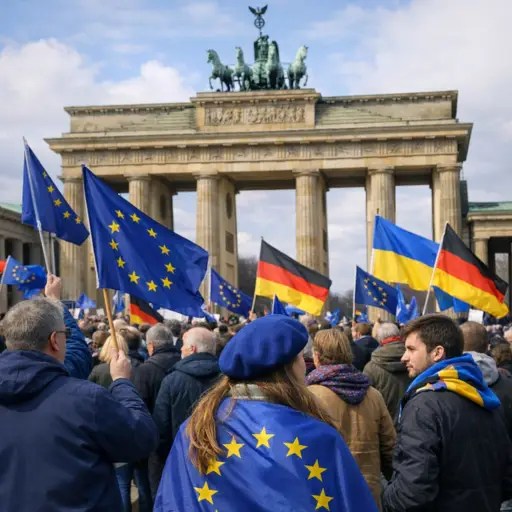
Beneath the winter sky at the Brandenburg Gate, a modest but determined crowd gathered waving blue and gold European flags, sending a clear message that Europe must remain united, democratic and resilient at a moment of political tension across the continent.
Around one hundred participants assembled at the symbolic heart of the German capital, describing their rally not as a protest against a single party or policy but as a public reaffirmation of shared European values including the rule of law, human dignity, freedom of expression and cross-border solidarity.
The demonstration unfolded as Germany stands at a political crossroads with voters heading to the polls and debates intensifying about the country’s future role within the European project, lending the gathering a broader resonance beyond its size.
Speakers addressing the crowd through portable loudspeakers stressed that Europe is not an abstract institution but a living framework of cooperation that protects rights, coordinates economies and seeks to resolve conflicts through dialogue rather than division.
The Brandenburg Gate, once a stark symbol of Cold War separation and later of reunification, provided a powerful backdrop for a renewed civic appeal to safeguard democratic norms at a time when both internal disagreements and external pressures are testing European cohesion.
Organisers pointed to geopolitical instability on the continent’s eastern flank, economic competition, energy challenges and persistent disinformation campaigns as reminders that unity cannot be taken for granted and must be actively defended by citizens.
Handmade banners calling for solidarity across borders and democracy without compromise were held by students, retirees, professionals and families, reflecting a cross-section of civil society united by concern for the future direction of the European Union.
Similar scenes played out in Barcelona, where activists gathered near prominent civic landmarks to advocate deeper integration and renewed civic engagement, and in Rome, where demonstrators invoked Italy’s historic role in the founding of the European community.
In Vienna, participants rallied with European flags in central squares, highlighting Austria’s position at the crossroads of Central Europe and urging leaders to uphold judicial independence and common democratic standards.
Though differing in scale and local context, the demonstrations shared a common emphasis on unity, civic responsibility and the defense of European values against both internal fragmentation and external interference.
Political analysts note that even relatively small gatherings can shape public discourse by signaling grassroots sentiment and reminding policymakers that a segment of the electorate remains strongly committed to supranational cooperation.
Participants repeatedly underscored that democracy is not self-sustaining and requires active engagement beyond the ballot box, calling on fellow citizens to counter misinformation, participate in public debate and support independent institutions.
The rallies also reflected heightened awareness of foreign interference in democratic processes, with speakers warning that safeguarding elections and strengthening media literacy are essential components of defending Europe’s political integrity.
Despite concerns, the tone across cities remained cautiously optimistic, with demonstrators expressing hope that renewed civic participation can reinforce the Union’s founding promise of peace, stability and shared prosperity.
As dusk fell over Berlin and the crowd gradually dispersed beneath the illuminated columns of the Brandenburg Gate, organisers pledged that their message would extend beyond a single gathering, insisting that Europe’s strength ultimately rests on the willingness of its citizens to stand together when it matters most.

 The Tower Post