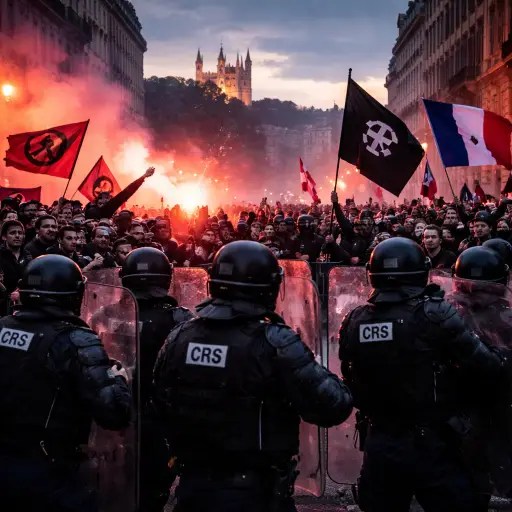
The death of far-right activist Quentin Deranque deepens ideological rifts as France braces for pivotal elections
France faces a renewed surge of political tension following the fatal stabbing of 23-year-old activist Quentin Deranque, an attack that has intensified divisions between far-right and far-left groups as the country moves through a decisive political season.
Deranque, described by supporters as a committed nationalist campaigner, was killed during an altercation in Lyon involving individuals authorities say are linked to radical left-wing circles, and while investigators continue to establish the precise sequence of events, the political fallout has unfolded with striking speed.
In the immediate aftermath, rival gatherings took place across Lyon, with candlelit vigils honoring the young activist and counter-demonstrations warning against extremist ideologies, prompting a heightened security presence in neighborhoods already accustomed to political mobilization.
President Emmanuel Macron appealed for unity in a national address, condemning political violence unequivocally and urging citizens to reject escalation, insisting that democratic competition must not descend into confrontation even as parties across the spectrum struggle to contain hardened rhetoric among their supporters.
Nationalist figures have portrayed the killing as a symptom of growing hostility toward their movement, calling for firm judicial measures and greater oversight of radical networks, while mainstream conservatives have attempted to distance themselves from incendiary language that could inflame tensions further.
Leaders within left-wing organizations have rejected any endorsement of violence, emphasizing that their activism is grounded in social justice and anti-racism, and cautioning that the tragedy should not serve as a pretext for broader restrictions on protest or association.
The episode has revived debate over political extremism in France, with lawmakers revisiting proposals aimed at strengthening surveillance of militant groups and clarifying legal thresholds for dissolution, even as civil liberties advocates warn against legislation shaped by emotion rather than evidence.
Security services have quietly expanded monitoring of groups considered vulnerable to confrontation, reflecting concerns that isolated incidents could trigger cycles of retaliation, particularly in urban centers where ideological activism remains highly visible and emotionally charged.
Residents of Lyon describe a city unsettled yet determined to avoid further bloodshed, with municipal leaders convening dialogue initiatives and community forums designed to defuse tensions and reaffirm a shared commitment to civic order.
Political analysts note that France’s polarization mirrors broader European patterns in which economic anxiety, identity politics, and digital echo chambers reinforce ideological divides, creating an atmosphere in which opponents are increasingly framed as existential adversaries rather than democratic competitors.
As electoral campaigns gather momentum, strategists face a delicate balance between mobilizing core supporters and preventing rhetoric that could deepen mistrust, a challenge underscored by the raw emotional reactions that have followed Deranque’s death.
For the young activist’s family and friends, national debate offers little comfort, as preparations for his funeral proceed under discreet but visible security, reflecting the symbolic weight the event now carries within a divided political landscape.
The coming period will test whether France’s leadership can channel public grief into renewed commitment to democratic norms and peaceful engagement, or whether this episode will mark another step toward entrenched polarization.
In a country where political expression has long been passionate and public, the central question now is whether that intensity can remain within the bounds of law and civic respect, as France confronts a moment that has exposed the fragility as well as the resilience of its democratic fabric.



 The Tower Post