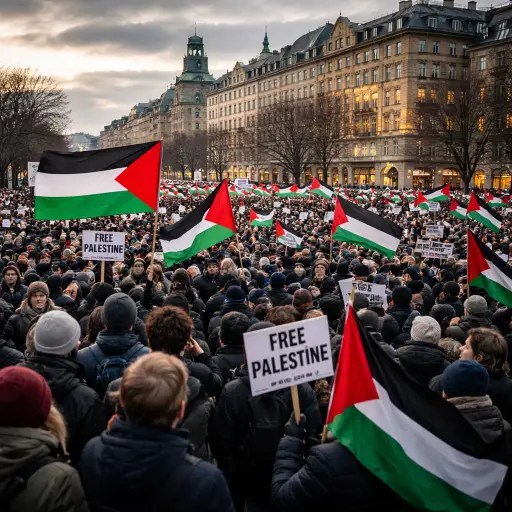
Demonstrators in Odenplan Square call for sanctions and urgent humanitarian action, signaling rising Scandinavian activism on Middle East policy
In biting winter air and beneath a pale Nordic sky, hundreds gathered in central Stockholm’s Odenplan Square to protest Israel’s administrative measures aimed at annexing parts of the occupied West Bank, standing shoulder to shoulder despite freezing temperatures as chants echoed across the plaza.
Wrapped in heavy coats, scarves and keffiyehs, demonstrators waved Palestinian flags while volunteers handed out leaflets outlining what organisers described as a decisive moment in the conflict, arguing that recent Israeli policy steps amount to a structural consolidation of control that could pave the way for formal annexation.
Speakers addressing the crowd from a small temporary platform urged the Swedish government and the European Union to respond with concrete measures, including targeted sanctions and a reassessment of cooperation agreements, insisting that diplomatic statements without consequences would only embolden further territorial expansion.
Organisers repeatedly linked developments in the West Bank to the worsening humanitarian situation in Gaza, telling the crowd that administrative changes on the ground cannot be separated from civilian suffering and calling for urgent humanitarian access, increased aid delivery and international accountability mechanisms.
The demonstration unfolded peacefully under the watch of a visible but restrained police presence, with officers redirecting foot traffic around the square as commuters slowed to observe the gathering, some stopping to join the protest while others listened briefly before continuing on their way.
Sweden has long cultivated a reputation for defending international law and human rights in its foreign policy, and several speakers argued that this tradition obliges Stockholm to take a leading role within the European Union should annexation proceed, warning that silence or hesitation would undermine that credibility.
Public engagement with Middle East issues has intensified across Scandinavia in recent months, with similar rallies reported in other Nordic capitals, reflecting a surge of activism particularly among younger citizens who have mobilised through student networks and social media platforms.
Political analysts note that while street protests do not automatically translate into policy shifts, sustained civic pressure can reshape public debate and influence the tone of parliamentary discussions, especially in countries where coalition governments are sensitive to grassroots movements.
As the winter daylight faded, demonstrators lit candles along the edges of the square and observed a moment of silence for civilians affected by violence, transforming the earlier chants into a quiet vigil that underscored the emotional gravity of a conflict reverberating far beyond the Middle East.
For many participants, the gathering represented not only opposition to annexation but also a broader assertion that international law must apply universally, and as the crowd dispersed into the cold evening air the message remained clear that public activism in Scandinavia is unlikely to subside while the crisis endures.


 The Tower Post