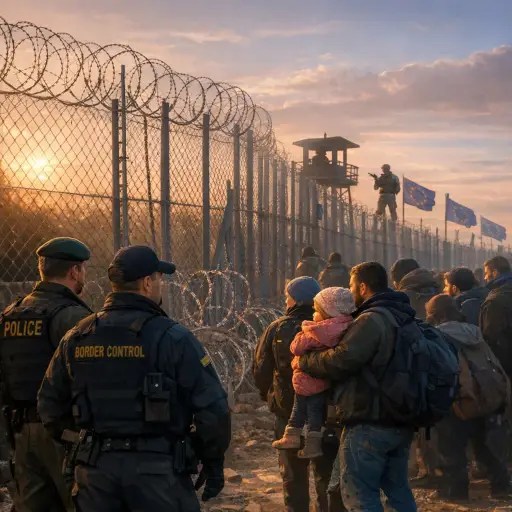
A Continent Reconsiders Its Borders, Its Values, and the Future of Integration
As late winter settles over the continent, Europe’s political atmosphere remains tense, shaped increasingly by debates over security, migration, and the fragile state of social cohesion. Across the European Union, leaders are recalibrating their language and legislative priorities, placing border control and asylum reform at the center of national and supranational agendas. What was once framed primarily as a humanitarian challenge is now discussed as a defining test of governance, sovereignty, and democratic resilience.
In parliamentary chambers and public squares alike, calls for stronger external border protections have grown louder. Policymakers argue that restoring confidence in migration systems is essential to preserving public trust in European institutions. Proposals emphasize faster asylum screenings at external frontiers, streamlined procedures for determining protection status, and more efficient return mechanisms for those denied entry. The objective, officials say, is clarity and control in a system long criticized as inconsistent and overburdened.
This shift reflects mounting pressures beyond Europe’s borders. Ongoing instability in neighboring regions, economic disparities, and protracted displacement crises continue to drive migration flows toward the continent. At the same time, domestic concerns about housing shortages, strained public services, and uneven integration outcomes have intensified political scrutiny. Migration is no longer debated in isolation; it is intertwined with questions about economic sustainability and national identity.
One of the most contentious terms entering mainstream discourse is “remigration,” a concept once confined to political fringes but now discussed more openly in certain circles. While interpretations vary, it broadly refers to policies encouraging or mandating the departure of migrants who lack legal status or are deemed insufficiently integrated. Supporters describe it as a necessary corrective to years of perceived policy drift, while critics warn that such rhetoric risks eroding commitments to equality and human rights embedded in European law.
Efforts to reform the EU’s common asylum framework seek to address long-standing disparities between member states. Frontline countries argue they shoulder disproportionate responsibility, demanding greater solidarity in relocation and funding. Other governments resist binding quotas, citing domestic political constraints. The resulting negotiations underscore a deeper tension between collective responsibility and national sovereignty that has long characterized the European project.
Security concerns have further sharpened the tone of debate. High-profile incidents involving individuals with migrant backgrounds have fueled arguments for enhanced vetting, intelligence sharing, and monitoring mechanisms. Although data often show complex and nuanced realities, public perception exerts powerful influence. Political leaders face electorates that increasingly equate effective migration management with broader guarantees of safety and order.
Yet Europe’s demographic trajectory complicates calls for restriction. Aging populations and labor shortages in healthcare, technology, agriculture, and construction sectors underscore the economic necessity of managed migration. Business leaders caution that an overly defensive posture could undermine competitiveness and innovation. The policy challenge lies in distinguishing between irregular migration that strains systems and structured pathways that sustain economic vitality.
Integration models are also undergoing reassessment. Governments in several member states are placing renewed emphasis on language acquisition, civic education, and workforce participation as prerequisites for long-term residency. The prevailing narrative stresses reciprocity: societies must provide opportunity and protection, while newcomers must embrace shared norms and legal obligations. Whether such recalibration strengthens cohesion or fosters exclusion remains the subject of intense debate.
Civil society organizations argue that integration cannot succeed without addressing structural barriers such as discrimination in employment and housing. They caution that stigmatizing rhetoric may alienate second-generation Europeans who already identify fully with their countries of birth. Social cohesion, they contend, depends not only on border management but also on inclusive institutions capable of building trust across cultural and socioeconomic divides.
Europe now stands at a defining juncture. The direction chosen will shape not only migration policy but the broader character of its democracies. One path emphasizes fortified boundaries and tighter definitions of belonging; another seeks a balance between enforceable rules and principled openness. As the continent navigates this pivotal moment, the decisions made will resonate far beyond border crossings, influencing the very meaning of European unity in a changing world.




 The Tower Post