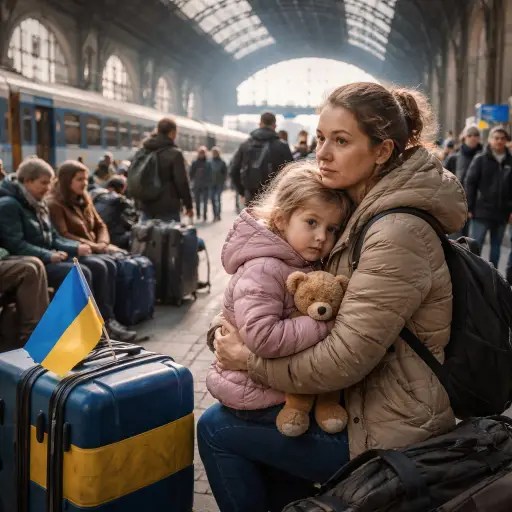
Displaced families across the continent face uncertain futures far from home as Russian attacks persist and hopes for peace remain faint

On the eve of another solemn anniversary of Russia’s full-scale invasion of Ukraine, millions of Ukrainians scattered across Europe find themselves suspended between a homeland at war and host countries that still call their presence temporary.
Nearly four years into the conflict, the emergency exodus that once dominated headlines has settled into a quieter but no less profound reality: families living in rented rooms, converted dormitories and modest apartments, waiting for clarity that has yet to come.
When Russian forces first advanced and missiles rained down on Ukrainian cities, European governments responded with rare unanimity, opening borders and activating temporary protection measures that granted Ukrainians the right to live and work across the European Union.
In cities such as Warsaw, Berlin and Prague, railway stations became gateways to safety, and volunteers offered food, transport and shelter in scenes that many described as historic acts of solidarity.
Today those arrivals have slowed, but the war has not, and neither has the uncertainty that shapes the lives of those who fled.
Across Poland, which hosts one of the largest Ukrainian communities abroad, classrooms have adapted to bilingual education and municipal offices continue to process renewals of legal status that arrive in increments rather than permanence.
Officials acknowledge both the depth of public generosity and the strains that accompany prolonged displacement, from rising housing costs to political debates that increasingly question long-term migration policies.
In Germany, integration programs have provided language training and access to social services, yet many Ukrainians struggle to secure stable employment that matches their qualifications, as professional credentials are not always fully recognized.
Women who arrived with children often face the dual challenge of finding work while navigating childcare shortages, even as they follow news from home with relentless attention.
In Spain and Italy, Ukrainian families have found relative refuge in coastal towns and industrial centers, taking jobs in hospitality, agriculture and construction, but wages frequently trail the surge in rents that has swept much of Europe.
For many, life has become a careful balancing act between building a semblance of stability abroad and preserving the option of return should conditions in Ukraine improve.
That improvement remains elusive as Russian drone and missile attacks continue to target energy infrastructure and residential districts, sending waves of anxiety through diaspora communities each time sirens sound in Kyiv, Kharkiv or Odesa.
Smartphones glow late into the night in European apartments as parents check messaging apps for reassurance from relatives who stayed behind, often separated by mobilization rules and the dangers of travel.
Children who once clutched toys in evacuation corridors now speak the languages of their host countries with ease, raising questions about identity and belonging that grow sharper with each passing school year.
Teenagers discuss university plans in Paris or Munich while grandparents remain in Ukraine, tending homes that may or may not still stand, bound by duty and circumstance to a country still under threat.
Humanitarian organizations warn that prolonged displacement carries psychological consequences, as trauma from sudden flight gives way to the quieter but corrosive stress of indefinite waiting.
Counselors report rising cases of anxiety and depression linked not only to memories of bombardment but to the grinding uncertainty over residency status, employment prospects and the possibility of reunification.
European policymakers continue to debate extensions of temporary protection frameworks, aware that abrupt policy shifts could push thousands into legal and economic precarity.
At the same time, elections and shifting political currents across the continent have elevated voices more skeptical of migration and wary of the financial commitments tied to long-term support for Ukraine.
In Kyiv, officials speak of resilience and reconstruction, sketching plans for rebuilding cities even as the war continues, but for displaced families abroad such visions hinge on security guarantees that remain distant.
Diplomatic initiatives have yet to deliver a comprehensive peace agreement, and the prospect of a negotiated settlement appears uncertain as fighting grinds on along entrenched front lines.
Some Ukrainians have chosen to return to regions they consider relatively safer, driven by homesickness and a desire to reclaim agency despite the risks.
Others maintain transnational routines, traveling back when possible to visit relatives or manage property, then returning to European cities where their children are enrolled in school.
For millions more, Europe has become a vast waiting room defined by short-term leases, renewable permits and lives planned in cautious increments.
Candlelight vigils and solidarity marches this week will mark another year of war, but for those living in limbo the symbolism offers only partial comfort.
As the conflict approaches its fourth year, the central question facing displaced Ukrainians is not only when they can return home, but what that home will look like when the guns finally fall silent.