Muted reception for Macron reflects mounting tensions over trade, subsidies and the future of European agriculture

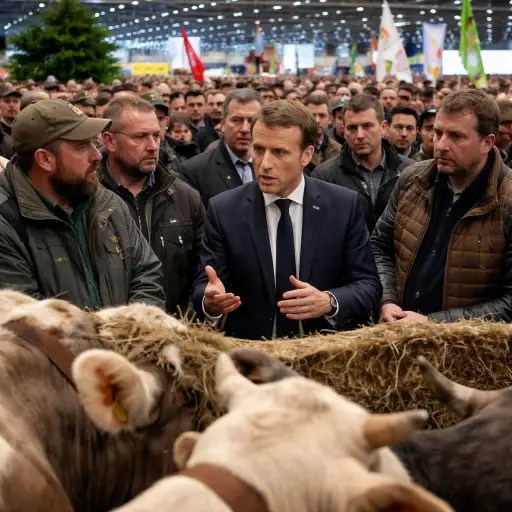
The vast exhibition halls of the Paris International Agricultural Show opened this week under bright lights and the low hum of livestock competitions, but the political atmosphere was markedly restrained as President Emmanuel Macron made his traditional tour of the stands.
The annual gathering, now in its sixty-second edition, has long served as a ritual encounter between France’s political leadership and its farming heartland, yet this year the handshakes were firmer than the applause and the smiles often gave way to sober exchanges about policy, prices and survival.
Farm union representatives, who have spent months voicing frustration in fields and on highways across Europe, used the event to underscore what they see as a growing disconnect between decision-makers in Paris and Brussels and the realities confronting producers on the ground.
Macron’s reception was subdued rather than openly hostile, but the symbolism was unmistakable as several union leaders challenged him publicly over trade negotiations, environmental standards and the direction of the European Union’s Common Agricultural Policy, known as the CAP.
For many farmers, the concern is not a single reform but an accumulation of pressures that include volatile input costs, climate-related disruptions, tightening environmental regulations and competition from imports produced under different standards.
Cereal growers spoke of shrinking margins as global markets fluctuate and compliance costs rise, while livestock producers described the strain of adapting to evolving animal welfare rules without corresponding price support from retailers or consumers.
Organic farmers, once buoyed by rapid growth in demand, said they now face a cooling market and higher certification expenses, adding another layer of uncertainty to an already fragile economic landscape.
The CAP negotiations have become a focal point of anxiety, as European institutions weigh budgetary constraints against ambitious environmental targets, leaving French unions determined to defend direct payments that many consider essential to farm viability.
Environmental advocates argue that subsidies must be tied more closely to biodiversity protection and emissions reductions, intensifying a debate that has placed agriculture at the center of Europe’s broader green transition strategy.
Macron, navigating these crosscurrents, acknowledged what he called the legitimate concerns of farmers and announced plans for renewed stakeholder talks aimed at simplifying administrative procedures and clarifying France’s position in ongoing European discussions.
He insisted that France would continue to push for what he described as agricultural sovereignty within the European framework, signaling support for clearer labeling of imported goods and safeguards in trade agreements that could affect domestic producers.
Yet much of the regulatory architecture shaping French agriculture is negotiated at the European level, limiting the scope for unilateral action and placing additional weight on Paris to influence debates in Brussels.
Political analysts note that rural discontent carries symbolic and electoral significance, as frustration in farming regions has increasingly translated into support for parties critical of European integration and skeptical of environmental mandates.
Inside the show’s bustling corridors, the contrast between heritage and uncertainty was striking, with award-winning cattle and regional specialties celebrating France’s agricultural identity even as conversations returned repeatedly to cost structures and policy fatigue.
Across Europe, similar tensions have surfaced in recent months, with tractors assembling in protest and union leaders warning that the social contract underpinning European agriculture is under strain.
European officials privately concede that the success of climate objectives depends on farmer participation, making compromise essential if reforms are to move forward without deepening divisions between rural communities and policymakers.
Macron’s proposal for structured dialogue may ease immediate tensions, but union representatives made clear that discussions must produce tangible results rather than symbolic gestures if confidence is to be restored.
As the show continues, it stands as a barometer of a continent wrestling with how to reconcile food security, environmental responsibility and economic fairness in an era of geopolitical and climatic uncertainty.
The subdued mood surrounding the president’s visit reflects a broader reckoning within Europe, where the future of agriculture is no longer a technocratic matter of subsidies but a politically charged question of identity, resilience and trust.