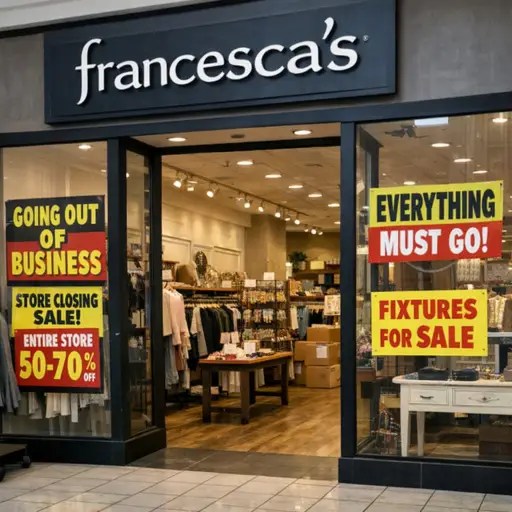
Iconic mall favorite enters full liquidation with steep discounts as retail pressures intensify
Francesca’s, the boutique-style fashion and accessories chain that became a staple of American shopping malls, is shutting down all 457 of its stores after filing for bankruptcy and moving into full liquidation, marking a dramatic end for a brand that once thrived on curated charm and impulse buys.
The company confirmed that liquidation sales are now underway across every location, with steep discounts expected to deepen in the coming days as inventory is cleared, fixtures are prepared for sale, and stores prepare to permanently close their doors.
Gift cards will be honored only through late February, after which balances will no longer be redeemable, a move that has prompted a rush of customers seeking to use remaining credits before the final deadlines tied to the wind-down process.
For years, Francesca’s built its identity around small-footprint boutiques designed to feel intimate and personal, offering rotating collections of dresses, jewelry, accessories and novelty gifts that encouraged browsing and discovery rather than mission-driven shopping.
That model, once considered a competitive advantage against larger department stores, became increasingly difficult to sustain in an era defined by online marketplaces, rapid shipping expectations and relentless price competition from digital-first brands.
According to restructuring documents, the retailer faced mounting operational costs, declining mall traffic and softer discretionary spending, conditions that collectively undermined efforts to stabilize revenue despite prior attempts to streamline store counts and expand e-commerce capabilities.
Retail analysts say the closure reflects broader structural stress across mid-sized specialty chains that lack both the scale efficiencies of big-box competitors and the hyper-local differentiation of independent boutiques able to cultivate tight community loyalty.
While some national retailers have successfully pivoted toward omnichannel strategies that blend digital and physical shopping, others have struggled to justify extensive mall footprints as consumers increasingly browse on smartphones rather than stroll through enclosed shopping centers.
Employees across the country have been informed that operations will cease once merchandise is depleted, with some staff retained temporarily to oversee liquidation events but all positions ultimately eliminated as the chain completes its shutdown.
Landlords and mall operators now face the sudden vacancy of hundreds of storefronts, intensifying pressure to repurpose traditional apparel spaces into dining concepts, entertainment venues, health services and experiential tenants better aligned with shifting consumer habits.
In many communities, Francesca’s was a reliable destination for graduation dresses, holiday party outfits and last-minute birthday gifts, creating an emotional connection that extended beyond transactions and into personal milestones.
Shoppers visiting stores during the final sales describe a mix of nostalgia and pragmatism, filling baskets with discounted accessories while pausing to take photos of displays that once signaled new arrivals and seasonal transitions.
Industry observers note that smaller boutique layouts, while visually appealing, limit inventory depth and flexibility, making it harder to compete against vast online assortments that can adjust pricing and product mix in real time without the burden of storefront rent.
The timing of the liquidation has temporarily boosted foot traffic as bargain hunters seek deep markdowns, yet analysts caution that such surges rarely translate into recovery for brands that have already exhausted restructuring options.
Returns and exchanges have been restricted under bankruptcy procedures, underscoring the finality of the company’s decision and the legal framework guiding the orderly disposition of remaining assets.
Francesca’s social media channels have adopted a reflective tone, thanking customers for years of loyalty and acknowledging the memories formed in fitting rooms and at checkout counters across suburban malls nationwide.
The shutdown adds to a growing list of once-familiar mall names that have struggled to adapt to structural shifts in retail, where convenience, price transparency and rapid fulfillment increasingly dictate purchasing behavior.
Even as certain retail segments show resilience, apparel remains especially sensitive to economic headwinds, with consumers trimming impulse purchases and prioritizing essentials amid persistent cost pressures.
For the broader retail industry, the liquidation stands as another signal that adaptation is no longer optional but essential, particularly for brands anchored in legacy mall environments that continue to see uneven recovery.
As final discounts deepen and store gates prepare to roll down for the last time, Francesca’s exit closes a chapter in American mall culture, leaving behind empty storefronts and a cautionary tale about the accelerating transformation of how consumers shop.




 The Tower Post