Budapest Signals It Will Block New Measures Unless Energy Security Concerns Are Addressed, Testing European Unity
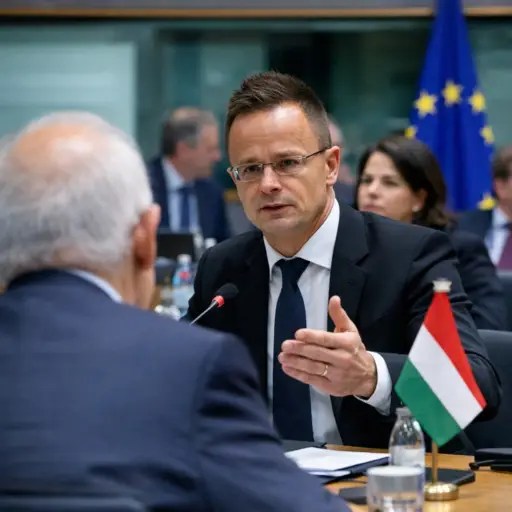
A fresh confrontation is unfolding at the heart of the European Union as Hungary publicly vows to veto the bloc’s next sanctions package unless its concerns over energy security are fully addressed, setting the stage for a tense debate among foreign ministers gathered in Brussels at a symbolic moment for Europe’s security debate.
Hungary’s government has made clear that it is prepared to block consensus at the Foreign Affairs Council, arguing that additional restrictive measures must not jeopardize member states’ access to essential supplies, particularly in the energy sector, where Budapest says national vulnerabilities remain acute.
Officials in Budapest insist that European decisions should not harm the economic stability of individual member states and that safeguarding affordable energy for households and businesses is a core responsibility of any government, even amid mounting geopolitical pressure.
The warning has intensified intra-EU tensions, with several delegations expressing frustration that unanimity rules continue to expose the bloc to last-minute brinkmanship, especially on issues seen as central to Europe’s strategic posture and credibility.
Energy policy has long been a sensitive fault line between Hungary and other EU capitals, as the country remains more dependent than many of its Western counterparts on external energy supplies, a structural reality that Hungarian leaders argue cannot be reversed overnight without severe economic consequences.
Prime Minister Viktor Orbán’s administration has framed its stance as pragmatic rather than obstructionist, contending that diversification of supply routes and sources requires time, investment and transitional safeguards that must be acknowledged in any new sanctions framework.
Several northern and eastern member states, among the strongest proponents of robust sanctions, counter that repeated veto threats undermine policy coherence and risk sending mixed signals to global partners at a time when the Union seeks to project unity and resolve.
Diplomats familiar with the negotiations describe a charged but cautious atmosphere in Brussels, where behind closed doors officials are exploring phased implementation schedules, targeted exemptions and possible financial support mechanisms aimed at offsetting disproportionate economic impacts.
The standoff has also revived a broader institutional debate about the EU’s decision-making architecture, as foreign policy remains governed by unanimity, granting each member state the power to block collective action and prompting renewed calls in some capitals for qualified majority voting in external affairs.
Hungary, along with a small group of like-minded states, has resisted such reforms, viewing unanimity as a vital safeguard of national sovereignty and a guarantee that smaller or more exposed economies are not overridden by larger members.
Financial markets have reacted cautiously to the uncertainty, with renewed volatility in energy prices reflecting concerns that delays or dilution of the sanctions package could complicate supply expectations and investor confidence across the region.
EU officials are acutely aware that beyond the technical details of sanctions design lies a broader messaging challenge, as visible divisions risk weakening the Union’s narrative of cohesion at a moment when public opinion remains sensitive to energy costs and inflation.
Hungarian representatives argue that their position reflects those domestic pressures, emphasizing that accountability to voters requires careful calibration between geopolitical commitments and economic resilience at home.
For many other member states, however, sanctions are not merely economic instruments but political statements of solidarity and deterrence, making the prospect of a veto especially consequential at this juncture in Europe’s evolving security landscape.
Whether compromise will emerge from the Brussels talks remains uncertain, but seasoned observers note that EU policymaking has often produced last-minute agreements after protracted negotiations, suggesting that flexibility may yet prevail over confrontation.
The episode nonetheless highlights the delicate equilibrium between national interests and collective ambition that defines the European project, as leaders navigate the tension between safeguarding sovereignty and maintaining strategic unity in an increasingly volatile international environment.


 The Tower Post