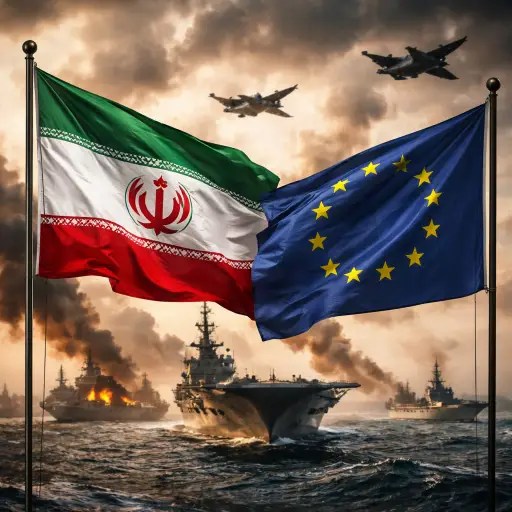
Tehran’s move follows new European measures tied to Iran’s alleged support for Russia, deepening a widening standoff between the Islamic Republic and key EU capitals.
Iran has formally designated several European Union naval and air force branches as terrorist entities, marking a sharp escalation in tensions between Tehran and European capitals and opening a new chapter in an already strained diplomatic relationship.
The announcement was delivered through Iran’s diplomatic channels and quickly amplified by state-affiliated media, which framed the move as a reciprocal response to recent European decisions targeting Iranian behavior linked to the war in Ukraine and alleged military cooperation with Moscow.
European authorities have intensified measures in recent weeks over what they describe as Tehran’s material and logistical backing of Russia, including claims of drone transfers and expanded defense coordination, accusations that Iranian officials continue to deny while condemning what they call politically motivated pressure.
In statements circulated by the foreign ministry, Iranian officials argued that certain European naval deployments in strategic waterways and expanded aerial patrol missions amount to destabilizing conduct that threatens regional security, asserting that the designation is grounded in sovereignty and legal reciprocity.
By labeling EU naval and air components as terrorist entities, Tehran has raised the rhetorical stakes significantly, signaling to domestic and international audiences that it is prepared to respond forcefully to European sanctions and diplomatic censure.
Officials in Brussels swiftly condemned the Iranian decision as baseless and inflammatory, warning that such language risks further isolating Tehran at a moment when diplomatic channels remain fragile and already strained by years of disagreement.
European representatives emphasized that their recent actions were designed to address specific concerns about Iran’s alleged support for Russia’s war effort and were not directed at the Iranian population, underscoring the distinction between targeted measures and broad punitive policies.
The confrontation highlights how the conflict in Ukraine continues to reverberate far beyond Eastern Europe, drawing in actors across the Middle East and reshaping diplomatic alignments as Western governments seek to constrain Moscow’s military capacity.
Iran, long accustomed to operating under multiple sanctions regimes, now finds itself navigating renewed scrutiny from European governments while balancing its strategic ties with Russia against the economic and political costs of further isolation.
Analysts suggest that Tehran’s designation carries greater symbolic weight than immediate operational consequences, as practical enforcement mechanisms remain unclear and direct interaction between Iranian forces and EU militaries is limited outside sensitive maritime corridors.
Nevertheless, symbolism in diplomacy can have tangible effects, and the decision complicates any future engagement by hardening narratives on both sides and narrowing the space for compromise.
European naval missions and coordinated air patrols have expanded in response to shifting security dynamics, and Tehran’s declaration directly challenges those collective efforts, potentially reinforcing calls within the bloc for a firmer stance.
Behind the public statements lies a deeper strategic calculation shaped by years of strained relations following the collapse of earlier nuclear diplomacy efforts and successive rounds of sanctions that eroded trust between Iran and European signatories.
Some observers view the current exchange as calibrated escalation rather than uncontrolled confrontation, noting that both sides appear to be signaling resolve while stopping short of direct military threats or immediate operational changes.
Even so, heightened rhetoric increases the risk of miscalculation, particularly in vital maritime routes where misunderstandings or minor incidents can rapidly escalate amid an atmosphere of suspicion.
In Tehran, officials maintain that their actions are defensive and legally justified, while European leaders insist their measures are rooted in international law and collective security obligations, reflecting fundamentally different interpretations of responsibility and restraint.
As the standoff deepens, prospects for near-term reconciliation appear limited, with both sides prioritizing demonstrations of firmness over renewed dialogue.
The episode serves as a stark reminder that geopolitical ripple effects from the war in Ukraine continue to shape diplomatic relations well beyond the battlefield, and that in the current climate even symbolic gestures can reverberate across regions and alliances.


 The Tower Post