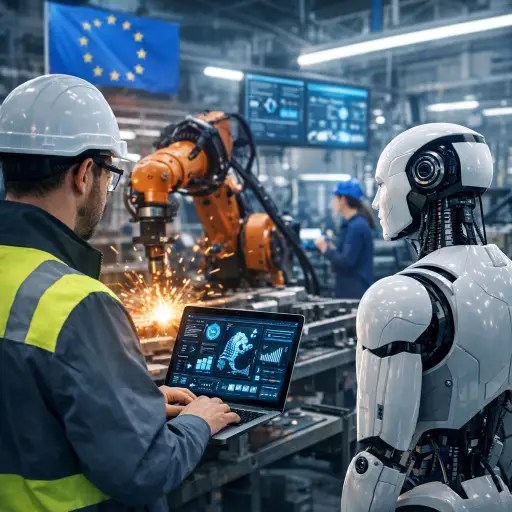
As policymakers pivot from invention to implementation, artificial intelligence is being embedded across manufacturing, logistics and services to reignite productivity and reposition Europe for the decade ahead.
Europe is reshaping its economic strategy around a simple but far-reaching idea: the continent does not need to dominate the invention of artificial intelligence to benefit from it, but it must lead in putting AI to work across its existing industrial base.
From Brussels to Berlin and from Paris to Madrid, policymakers and business leaders are converging on a pragmatic growth agenda centered on adoption rather than frontier rivalry, arguing that widespread deployment of intelligent systems in traditional sectors could unlock a new cycle of productivity gains.
While the United States and parts of Asia continue to command the spotlight in advanced AI models and chip design, Europe is betting on its dense manufacturing ecosystem, highly skilled workforce and deep network of small and medium-sized enterprises to translate digital capability into tangible economic performance.
Factories are emerging as the frontline of this transformation, with AI-driven predictive maintenance reducing unexpected breakdowns, machine learning systems optimizing production schedules in real time and computer vision tools detecting microscopic defects before products leave the assembly line.
Executives say these technologies are less about replacing workers and more about augmenting them, equipping engineers and technicians with data-rich insights that cut waste, lower energy use and sharpen quality control while preserving Europe’s industrial expertise.
Economists note that productivity revolutions rarely stem from isolated breakthroughs alone, but from the steady diffusion of technology across entire sectors, and they argue that artificial intelligence may follow the same historical pattern once seen with electrification and automation.
Logistics networks, vital to Europe’s export-driven economy, are also undergoing an AI-enabled overhaul as algorithms analyze traffic patterns, port congestion and customs flows to reroute shipments dynamically and strengthen supply chain resilience.
Warehouses increasingly rely on adaptive robotics and predictive demand forecasting to streamline inventory management, reducing storage costs and improving delivery times in ways that ripple across retail, manufacturing and wholesale distribution.
The service sector, which accounts for the majority of European economic output, is joining the shift as banks deploy AI to automate compliance and fraud detection, hospitals integrate diagnostic algorithms into imaging workflows and public administrations experiment with digital tools to modernize citizen services.
For smaller firms that form the backbone of Europe’s economy, cloud-based AI platforms are lowering entry barriers by offering scalable analytics and automation without requiring vast in-house research departments, helping to spread productivity gains beyond major industrial champions.
Public investment strategies are increasingly aligned with this diffusion model, combining digital infrastructure upgrades, targeted industrial policy and workforce training initiatives aimed at strengthening data literacy and technical skills across regions.
Regulatory frameworks are evolving in parallel, with lawmakers seeking to provide clarity on data governance and accountability in order to build trust in AI systems while avoiding excessive burdens that could discourage innovation.
Supporters contend that predictable rules can reduce uncertainty and attract long-term capital, whereas critics warn that Europe must remain agile if it is to compete in a rapidly shifting technological landscape.
The economic stakes are high as the continent confronts demographic pressures, the financial demands of the energy transition and intensifying geopolitical competition, all of which heighten the urgency of reigniting sustainable productivity growth.
By positioning artificial intelligence as a horizontal enabler embedded across established industries, Europe is attempting to modernize its growth model without abandoning its industrial identity, seeking leadership in applied AI rather than solely in technological invention.
As AI adoption accelerates across factory floors, transport corridors, offices and clinics, Europe’s experiment in broad-based implementation is emerging as a defining feature of its economic strategy, one that could shape competitiveness and resilience for years to come.



 The Tower Post