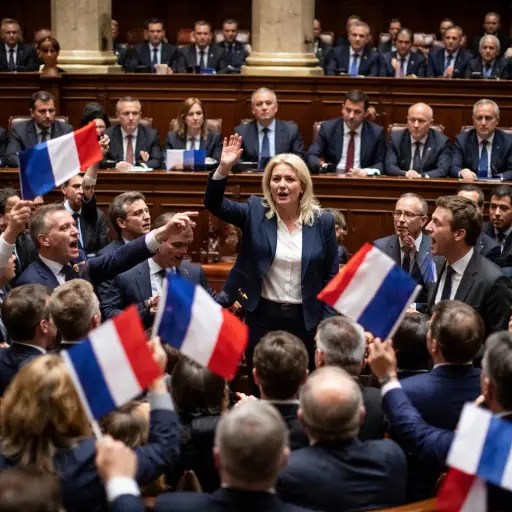
National Rally files no-confidence motion, deepening political rifts and testing executive authority amid energy transition backlash

France’s political landscape has entered a new phase of turbulence as the far-right National Rally submitted a no-confidence motion against the government following the enactment of a contentious energy reform law, triggering renewed uncertainty in the National Assembly and across financial markets.
The motion, introduced after the government finalized legislation designed to accelerate the country’s energy transition, represents one of the most serious parliamentary challenges faced by the executive in recent months and underscores widening fractures within the French political system.
At the center of the dispute is a sweeping reform intended to modernize France’s energy framework by expanding renewable capacity, streamlining project approvals, recalibrating electricity pricing mechanisms, and reaffirming state backing for next-generation nuclear reactors.
Government officials argue the law is essential to reinforce national energy sovereignty, stabilize long-term supply, and align the country with broader European decarbonization goals at a time when geopolitical tensions continue to expose vulnerabilities in continental energy markets.
National Rally leader Marine Le Pen and senior party figures have denounced both the substance of the reform and the manner of its adoption, accusing the government of bypassing meaningful parliamentary consensus and marginalizing dissenting voices in the legislative process.
In statements delivered inside the Palais Bourbon, party lawmakers framed the no-confidence motion as a defense of democratic procedure and household purchasing power, contending that the reform risks raising costs for families already strained by inflationary pressures.
While few analysts expect the motion to secure the absolute majority required to bring down the government, its political significance lies in its capacity to consolidate opposition forces and amplify public dissatisfaction over energy prices and industrial uncertainty.
The energy law seeks to balance France’s historic reliance on nuclear power with an accelerated rollout of wind and solar infrastructure, a dual strategy officials describe as pragmatic and necessary to ensure resilience in an evolving energy landscape.
Critics from both the right and segments of the left warn that the reform may create regulatory ambiguities and transitional costs that could undermine industrial competitiveness, particularly in energy-intensive sectors such as manufacturing, chemicals, and heavy industry.
The episode revives memories of earlier legislative confrontations that strained the executive’s parliamentary alliances and exposed the fragility of governing without a clear majority in the Assembly.
For the National Rally, the initiative fits within a broader strategy of positioning itself as the principal defender of economic sovereignty and social protection, themes that have resonated strongly with segments of the electorate in rural and peri-urban regions.
Across the political spectrum, reactions have been fragmented, with some center-right lawmakers criticizing the government’s tactics while stopping short of endorsing the motion, and left-wing parties divided between climate ambition and social cost concerns.
Public opinion appears complex and evolving, as surveys indicate general support for expanding renewable energy while revealing persistent anxiety about how the financial burden of transition policies will be distributed among consumers and businesses.
International observers are monitoring the situation closely given France’s central role within the European Union’s energy coordination efforts, where domestic instability could complicate negotiations on market integration and infrastructure investment.
In the Assembly chamber, the upcoming debate is expected to crystallize competing visions of France’s economic future, pitting arguments about environmental urgency against concerns over affordability, industrial strategy, and democratic legitimacy.
Even if the government survives the vote, the confrontation illustrates the growing politicization of energy policy in a country long accustomed to treating electricity production as a largely technocratic domain.
Markets and industry leaders will be watching for signs of sustained institutional strain, mindful that repeated parliamentary standoffs risk eroding investor confidence during a period of structural economic transformation.
The no-confidence motion ultimately reflects deeper tensions over identity, sovereignty, and the pace of change in contemporary France, tensions that are likely to shape the national political debate well beyond the immediate parliamentary showdown.