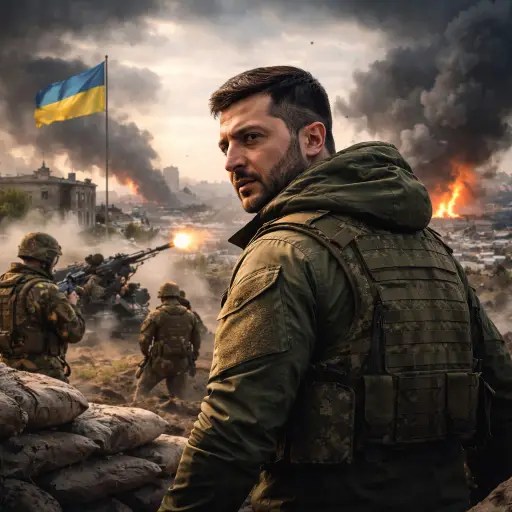
Ukrainian leader says Kyiv’s resistance remains the frontline buffer against wider conflict, urging allies to sustain support amid mounting geopolitical strain
As Europe marks four years of war in Ukraine, President Volodymyr Zelenskyy has issued one of his starkest warnings yet, saying the conflict now carries risks far beyond Ukraine’s borders and could ignite a broader global confrontation if Russia’s aggression is not firmly contained.
Speaking as the anniversary draws renewed international attention, Zelenskyy framed Ukraine’s resistance not only as a national fight for sovereignty but as a defensive shield protecting Europe and the wider international order from deeper instability.
“What happens here does not stay here,” he said in remarks aimed at both domestic audiences and Western capitals, arguing that if aggression is rewarded the consequences will extend well beyond the battlefield.
The war enters another year with active front lines in the east and south, where Ukrainian and Russian forces remain locked in grinding combat defined by artillery exchanges, drone warfare and strategic strikes on infrastructure.
While territorial changes have often been incremental, the geopolitical stakes have steadily increased, with Moscow testing Western unity through sustained military pressure and political signaling.
Zelenskyy warned that any weakening of international support could embolden the Kremlin and heighten the risk of a wider confrontation that might draw in other powers, underscoring his view that Ukraine’s defense is inseparable from European security.
European leaders marking the anniversary echoed concerns about escalation, though their statements also reflected the strain of prolonged conflict after years of financial aid, military assistance and sweeping sanctions.
Governments across the European Union face domestic pressures ranging from economic uncertainty to political fragmentation, complicating what was once near-unanimous backing for Kyiv.
Even so, senior EU officials reaffirmed commitments to continued assistance, describing Ukraine’s stability as essential to preserving the credibility of international law and the postwar security framework on the continent.
Ceremonies honoring victims of the conflict were accompanied by renewed pledges of defense packages and reconstruction support, signaling that despite fatigue the alliance remains engaged.
Behind closed doors, policymakers are increasingly debating the sustainability of long-term aid, particularly as other global crises compete for attention and resources.
Zelenskyy’s renewed warning about the possibility of a broader world war appeared designed to sharpen that debate and remind partners of the potential cost of disengagement.
Military analysts say the conflict has evolved into a technologically complex war of attrition in which drones, cyber operations and long-range precision weapons blur traditional front lines and raise the danger of miscalculation.
A stray strike, an unintended spillover or a misread signal could carry consequences far beyond Ukraine, reinforcing concerns about escalation in a tense security environment.
For Ukrainians, the anniversary is both symbolic and deeply personal, as nearly every community continues to endure displacement, loss and economic hardship.
Yet public resolve remains visible in volunteer networks, military recruitment and civic displays of solidarity that underscore a society adapted to life under constant threat.
Across Europe, solidarity gatherings highlighted both empathy and anxiety, with crowds calling for peace and accountability while leaders weighed long-term defense strategies and energy security.
Zelenskyy emphasized that Ukraine does not seek to widen the war but to prevent its expansion, repeating his assertion that sustained support now may avert far greater costs later.
As the conflict moves into its next phase, negotiations appear distant and trust between Moscow and Kyiv remains virtually nonexistent, leaving the battlefield and diplomatic channels in a prolonged stalemate.
For Europe and its allies, the anniversary serves as both commemoration and warning, underscoring that the outcome will shape the continent’s security architecture and the resilience of democratic alliances for years to come.
Whether Zelenskyy’s appeal galvanizes renewed unity or exposes fractures within the coalition may determine the trajectory of the war and the stability of a fragile global order.



 The Tower Post