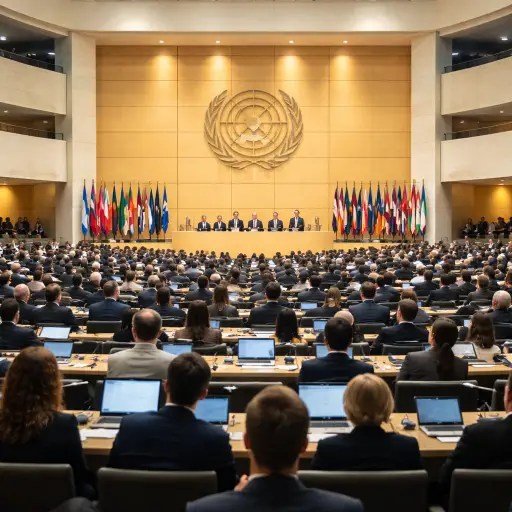
European states press the case for rule of law at the United Nations, arguing that democratic norms are essential to global stability
International law and democratic security have moved to the forefront of debate at the United Nations in Geneva, where European delegations are mounting a coordinated effort to reaffirm the rule of law as the cornerstone of global stability amid rising geopolitical strain and institutional uncertainty.
Gathered in conference halls overlooking Lake Geneva, diplomats describe the current moment as one defined by armed conflict, democratic erosion, cyber interference and intensifying rivalry between major powers, developments that have sharpened questions about whether the postwar legal architecture can endure mounting pressure.
European representatives argue that reinforcing international legal commitments is not an abstract exercise but a practical necessity, maintaining that predictable rules and accountable governance reduce the risk of escalation and create conditions for sustainable peace.
Throughout plenary sessions, speakers have repeatedly invoked the United Nations Charter, international humanitarian law and binding human rights treaties as obligations that demand consistent application rather than selective interpretation shaped by political convenience.
Officials from several European capitals framed democratic security as a strategic imperative, asserting that transparent institutions, independent courts and credible electoral systems form protective barriers against corruption, disinformation and destabilizing external influence.
In closed consultations, delegates expressed concern over what they see as a growing normalization of impunity in certain conflict zones, warning that failure to uphold legal standards weakens deterrence and encourages unilateral action outside established frameworks.
A central element of the European position is renewed support for international adjudication, with diplomats emphasizing the role of global courts and investigative mechanisms in resolving disputes peacefully and reinforcing accountability.
Human rights protections have featured prominently in the discussions, as representatives stressed that civil liberties, free media and robust civil societies are not purely domestic considerations but essential components of a stable international environment.
Some member states have voiced reservations about linking democratic governance too directly to security debates, cautioning that such framing risks politicization or the perception of imposed value systems.
European delegates responded by underscoring that the norms under discussion are embedded in treaties voluntarily ratified by sovereign governments, arguing that defending these commitments amounts to upholding agreed legal standards rather than advancing ideological agendas.
Policy analysts attending side events observed that Geneva has evolved into a critical arena for contestation over the meaning and enforcement of international norms, serving as a hub for treaty bodies, legal scholars and advocacy groups shaping global discourse.
Security experts noted that domestic adherence to rule of law strengthens a state’s credibility abroad, while internal institutional decay often correlates with unpredictability in foreign policy and reduced compliance with international obligations.
Civil society organizations participating in the meetings called for stronger safeguards for journalists and human rights defenders, describing them as frontline actors in identifying early warning signs of democratic backsliding.
The European initiative unfolds at a time when multilateral institutions face skepticism and shifting alliances complicate consensus building, yet proponents insist that retreat from a rules-based system would accelerate fragmentation and heighten instability.
Across formal sessions and informal exchanges, delegates returned to a common refrain that global order depends on reliable norms and credible enforcement, and that without them power politics risks filling the vacuum.
As negotiations continue, the diplomatic outcome remains uncertain in a polarized environment, but the discussions in Geneva signal a determined effort by European states to anchor international security debates firmly within the framework of law and democratic governance.
In the United Nations chambers where legal doctrine meets political reality, the debate reflects a broader struggle over whether established norms can adapt to new technological threats, hybrid conflicts and evolving geopolitical dynamics.
For the European diplomats leading the push, the message is consistent: the durability of international peace rests on the strength of legal commitments and the resilience of democratic institutions that transform written principles into lived practice.




 The Tower Post