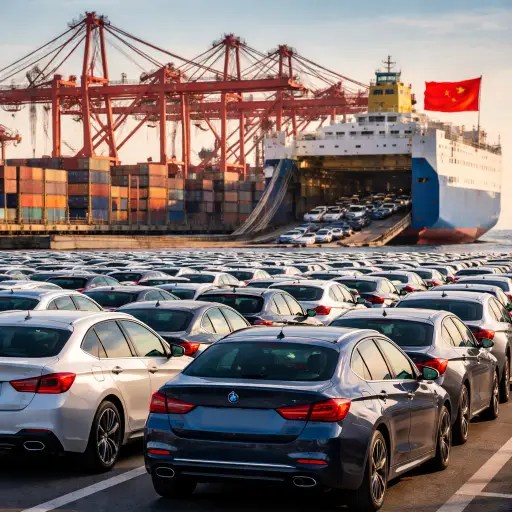
German car exports to China plunge by roughly one-third, shaking the foundations of Europe’s industrial engine
Germany’s automotive powerhouse is confronting a jolt that few executives, workers or policymakers believed would arrive so abruptly, as car exports to China have plunged by roughly one-third, marking one of the sharpest reversals in the modern history of Europe’s flagship manufacturing sector.
For decades, China stood as the indispensable growth market for Germany’s premium brands, anchoring business models built on relentless demand for combustion engines and, more recently, high-end electric vehicles, while sprawling production hubs in Bavaria and Baden-Württemberg calibrated output to the rhythms of Chinese consumption.
That assumption has now fractured, and industry leaders increasingly describe the contraction not as a routine cyclical dip but as a structural recalibration driven by the rapid maturation of China’s domestic automakers and a decisive shift in competitive dynamics.
Chinese manufacturers, particularly in the electric vehicle segment, have accelerated innovation cycles, refined battery technology and leveraged scale efficiencies with remarkable speed, producing models that match or undercut European rivals on price while closing historic gaps in perceived quality and software integration.
The result is a dramatic cooling of demand for German-built vehicles shipped from European ports to Chinese showrooms, a development that is reverberating far beyond the factory gates and into the broader architecture of Europe’s export-driven economy.
Automotive manufacturing is not merely another sector in Germany; it is the backbone of industrial employment, a symbol of technological prowess and a linchpin of trade surpluses that have long underpinned economic stability, meaning that any sustained decline in overseas demand carries outsized consequences.
Across central Europe, thousands of small and medium-sized suppliers that produce precision components, electronic systems and specialized materials are tethered to German production volumes, and many are now reassessing forecasts as order books soften and shipment schedules thin out.
Port operators along the North Sea and Baltic coasts report visibly lighter flows of outbound vehicles bound for East Asia, while logistics providers speak of recalibrated capacity planning as the once dependable artery of trade between Germany and China narrows.
The downturn arrives at a delicate moment, as European manufacturers are already navigating the costly transition to electrification, grappling with elevated energy prices and investing heavily in software capabilities to remain competitive in a digitalized mobility landscape.
Executives at leading automakers have publicly reaffirmed their long-term commitment to the Chinese market, emphasizing partnerships and localized production strategies designed to align more closely with consumer preferences and regulatory expectations within China itself.
Behind the scenes, however, strategic recalibration is unmistakable, with companies accelerating joint ventures, deepening local supply chains in China and exploring new export destinations in Southeast Asia, India and North America in an effort to dilute dependence on a single external market.
Yet diversification poses formidable challenges, because no other market matches China’s scale, speed of adoption and appetite for new energy vehicles, leaving a gap that cannot easily be filled by incremental gains elsewhere.
Labor representatives are voicing concern that prolonged weakness could translate into production adjustments and eventually workforce reductions, even if no immediate wave of layoffs has materialized, underscoring how closely employment prospects are tied to export performance.
The implications stretch beyond jobs and into the geopolitical fabric of global trade, as the slump highlights the risks inherent in deep interdependence at a time of strategic rivalry, industrial policy assertiveness and shifting regulatory frameworks.
Policymakers in Berlin and Brussels are weighing how to reinforce competitiveness without igniting protectionist escalation, balancing calls for strategic autonomy in batteries, semiconductors and green technologies with the realities of an interconnected global supply chain.
Some analysts argue that the setback could catalyze overdue reform, prompting Europe to intensify investment in domestic innovation ecosystems and to streamline regulatory burdens that have sometimes slowed the commercialization of next-generation mobility solutions.
Others caution against overreaction, noting that German brands retain formidable reputations for engineering excellence and safety, and that a renewed emphasis on advanced software architectures and premium electric platforms could restore lost ground over time.
Still, the symbolism is potent, because for years Germany’s automotive juggernaut was viewed as nearly unassailable, thriving on the premise that global demand for its vehicles would remain resilient even amid political and economic turbulence.
Now, on this late February day, the shock is still reverberating through boardrooms and factory floors alike, forcing a sober reassessment of assumptions that once seemed foundational to Europe’s industrial strategy.
Whether this contraction proves to be a temporary stumble or a deeper turning point will depend on how swiftly companies adapt to the evolving competitive landscape and how effectively policymakers cultivate conditions for innovation, investment and resilience.
For Europe’s auto heartland, the message is unmistakable: the era of automatic export growth to China has ended, and the road ahead will require strategic agility, technological boldness and a reimagining of how industrial strength is sustained in a more fragmented global economy.



 The Tower Post