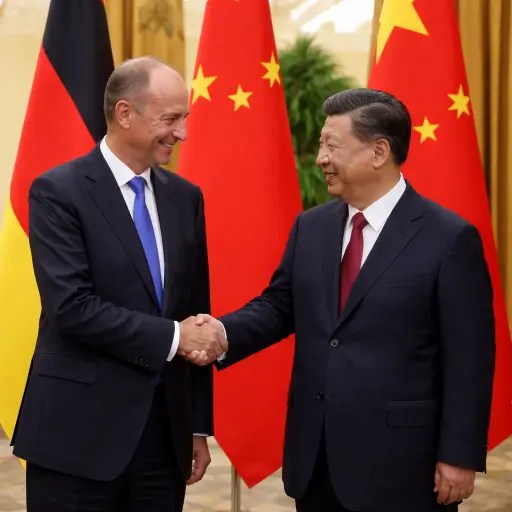
German Chancellor Friedrich Merz meets Xi Jinping in Beijing as Europe recalibrates its economic strategy amid mounting trade tensions
In a carefully choreographed visit underscoring both interdependence and unease, German Chancellor Friedrich Merz met Chinese President Xi Jinping in the Chinese capital this week, pressing for fairer market access while signaling that Berlin does not seek economic decoupling from the world’s second-largest economy.
The encounter unfolded against a backdrop of growing trade friction between the European Union and China, intensified scrutiny of industrial subsidies, and rising geopolitical competition among major powers, yet both leaders publicly emphasized dialogue and stability, reflecting the high stakes of a relationship that binds Europe’s largest economy to one of its most critical trading partners.
Standing beside Xi in Beijing’s grand state reception hall, Merz urged China to address what he described as structural imbalances in bilateral trade, as German officials have voiced concern over restricted access for European firms in key sectors, opaque regulatory frameworks, and the surge of competitively priced Chinese exports, particularly electric vehicles and green technologies, into European markets.
China, for its part, presented itself as a defender of global trade at a time when protectionist currents are rising elsewhere, with Xi characterizing China as a reliable partner committed to multilateralism and open markets while stressing the need for cooperation in an era of economic fragmentation.
The tone was diplomatic, but the substance reflected mounting tension as Germany’s export-driven economy has long relied on Chinese demand, especially in automotive manufacturing, machinery, and chemicals, yet as Chinese industrial policy has advanced and domestic champions have grown more competitive, German companies increasingly find themselves competing on less favorable terms.
Business leaders accompanying the chancellor echoed concerns about market reciprocity, with several executives privately noting that while European markets remain broadly open, foreign firms in China continue to face joint-venture requirements, data localization rules, and informal barriers that complicate long-term investment planning.
Merz’s visit comes at a delicate moment for the European Union, as Brussels has launched investigations into Chinese state support in strategic sectors and has signaled a willingness to deploy trade defense instruments if necessary, while policymakers remain wary of triggering a full-scale trade confrontation that could damage fragile economic recovery across the bloc.
In Beijing, Xi struck a confident tone, portraying China as a stabilizing force in global commerce, emphasizing supply chain resilience and urging Europe to resist what he described as external pressures that could distort economic cooperation, a remark widely interpreted as a reference to broader geopolitical rivalries influencing global trade policy.
The meeting also highlighted the complexity of Europe’s approach to China, often described in Brussels as a partner, competitor, and systemic rival simultaneously, with Germany as Europe’s largest economy sitting at the center of that balancing act and carrying significant influence over the direction of EU policy.
Merz has sought to recalibrate Berlin’s China strategy without severing deep economic ties built over decades, arguing in recent remarks for de-risking rather than disengagement and advocating diversification of supply chains while preserving commercial channels that benefit both sides.
Analysts note that Germany’s position reflects internal pressures, as industrial regions fear losing access to Chinese markets while political leaders face calls to shield domestic industries from what they view as unfair competition, even as China remains indispensable for Europe’s green transition by providing critical raw materials and large-scale manufacturing capacity for renewable technologies.
During closed-door talks, officials said discussions extended beyond trade to include climate cooperation, global governance reform, and regional security issues, and while few concrete breakthroughs were announced, both sides agreed to continue dialogue through established economic and diplomatic mechanisms.
Observers describe the outcome as measured but meaningful, arguing that the symbolism of engagement at a time when global economic blocs appear to be hardening carries its own significance, as neither Berlin nor Beijing appears ready to escalate tensions dramatically, yet neither is willing to concede ground on core economic interests.
For the European Union, the challenge lies in forging a unified strategy, with some member states advocating a firmer stance toward Beijing while others prioritize continued commercial engagement, leaving Germany to navigate both national interests and the collective framework of EU trade policy.
As global competition intensifies in advanced manufacturing, digital infrastructure, and green technology, the EU-China relationship is likely to remain complex and occasionally contentious, shaped by overlapping cooperation and rivalry that define the current international economic landscape.
For now, Merz’s visit signals an attempt to steady the relationship without ignoring its strains, while Xi’s message underscores China’s effort to frame itself as a champion of open trade even as debates over reciprocity and fairness deepen across European capitals.
The meeting did not resolve the underlying tensions shaping Europe-China economic ties, but it demonstrated that despite sharper rhetoric and growing suspicion, dialogue remains the chosen path in a relationship where economic power and geopolitical influence are increasingly intertwined.

 The Tower Post