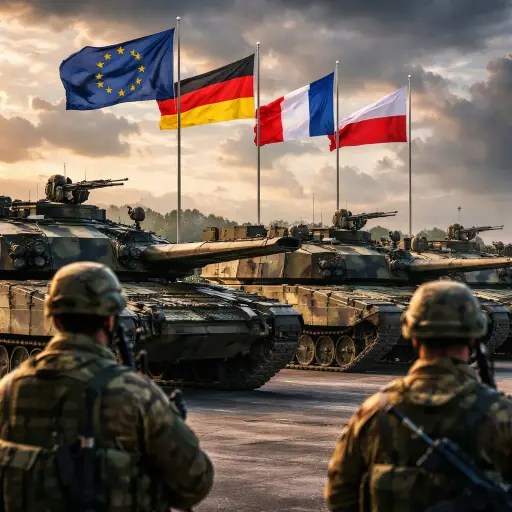
With Washington tempering growth in military budgets, European nations accelerate investment, reshaping the balance of global defence spending and redefining transatlantic security dynamics.
Europe is entering a decisive new chapter in its security policy as governments across the continent expand defence budgets, accelerate procurement programmes and rebuild industrial capacity at a pace not seen in decades, marking a structural shift in how the region approaches collective security.
The surge in spending comes as the United States slows the growth of its own defence outlays, prompting European capitals to assume a greater share of responsibility within the transatlantic alliance and altering the balance of global military expenditure.
European military investments now account for more than one fifth of total global defence spending, a share that has steadily increased as American budget expansion moderates, signalling a redistribution of financial weight within the Western security architecture.
Pressure within NATO for allies to meet and exceed spending commitments has intensified amid heightened security concerns along the Alliance’s eastern flank, and European leaders have responded by moving defence to the centre of fiscal and political debate rather than treating it as a secondary priority.
Recent adjustments to European Union fiscal rules have provided governments with greater flexibility to prioritise security expenditure, reflecting a growing consensus in Brussels that defence investment is compatible with economic stability and long term growth.
The continuing war in Ukraine has reshaped strategic calculations across the continent, exposing weaknesses in ammunition stockpiles, air defence systems and supply chains while underscoring the urgency of sustained readiness and industrial resilience.
Defence manufacturers from the Baltic to the Mediterranean are expanding production lines, reopening dormant facilities and investing in advanced technologies ranging from missile systems and drones to cyber capabilities and integrated air defence networks.
Germany has embedded long term rearmament plans into its federal budget, directing resources toward next generation aircraft, digital command infrastructure and missile defence, signalling a durable transformation in a country once cautious about military expansion.
France is reinforcing its doctrine of strategic autonomy by strengthening domestic production and deepening European collaboration, while Poland and several eastern member states accelerate procurement programmes in response to their proximity to Russia.
Southern European nations are increasing naval and aerospace capabilities to secure maritime routes and protect critical energy infrastructure, broadening the geographic scope of Europe’s defence recalibration beyond the eastern frontier.
In Washington, defence spending remains substantial but faces competing domestic fiscal pressures and evolving strategic priorities that emphasise technological innovation and force modernisation rather than rapid budget growth.
American officials continue to reaffirm their commitment to NATO while stressing that Europe must take greater responsibility for its own defence, a message that resonates more strongly in European capitals than at any time in recent decades.
For NATO, a stronger European pillar promises enhanced deterrence and operational resilience, yet coordination challenges persist over procurement standards, industrial fragmentation and the balance between strategic autonomy and alliance cohesion.
The European Commission has promoted joint procurement initiatives and common industrial strategies designed to reduce duplication and foster cross border cooperation, arguing that collective investment can yield both security dividends and economic stimulus.
Financial markets have responded as shares in major European defence firms climb on expectations of sustained demand, reflecting investor confidence that increased military spending represents a structural shift rather than a temporary surge.
Public opinion has evolved as well, with growing segments of European electorates supporting higher defence budgets in light of perceived threats and a broader recognition that security underpins prosperity and political stability.
The transformation unfolding across Europe is not merely financial but psychological, signalling a recalibration of the continent’s long standing reliance on American military power and an emerging conviction that credible strength is essential to strategic autonomy.
As February draws to a close, policymakers frame the expansion as a long horizon commitment to resilience, deterrence and alliance cohesion in an increasingly uncertain global environment.
Whether rising expenditure will translate into fully integrated capabilities remains an open question, yet the trajectory is unmistakable as Europe consolidates its role as a central actor in global security and redefines the contours of the transatlantic partnership.


 The Tower Post